

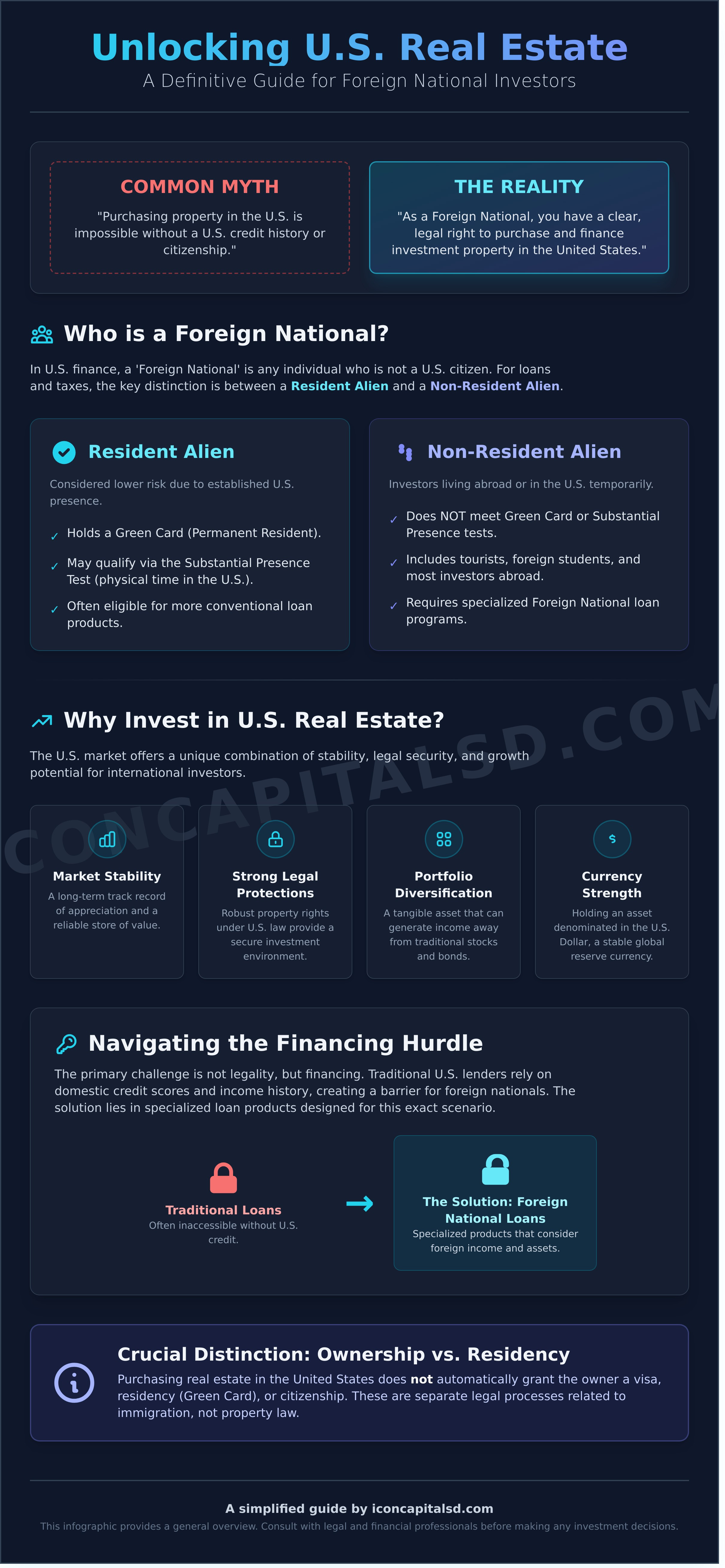
The U.S. real estate market offers significant opportunities, but for many international investors, the path to acquisition seems blocked by complex regulations, financing hurdles, and legal uncertainty. The belief that purchasing property without a U.S. credit history is impossible is a common and costly misconception. The reality is that as a Foreign National, you have a clear, legal right to purchase and finance investment property in the United States.
This guide eliminates the complexity. We provide a direct, step-by-step framework for navigating the entire process, from verifying your eligibility to closing the deal. You will learn the specific loan options available to non-resident investors, understand the key tax and legal considerations, and gain the confidence to leverage U.S. real estate to scale your portfolio. Consider this your definitive roadmap to successful cross-border property investment.
Key Takeaways
- Understand the legal framework that permits foreign investors to purchase and own real estate assets in the United States.
- Identify the primary financing challenge for a Foreign National and learn about specialized loan products designed to overcome it.
- Prepare the core documentation required for U.S. property loan qualification by following a clear, structured checklist.
- Develop a strategy to navigate common challenges in the U.S. real estate market, from property acquisition to financing.
What is a Foreign National in the U.S. Context?
In the context of U.S. finance and real estate, a foreign national is any individual who is not a citizen of the United States. This classification is a starting point for determining eligibility for specific financial products, including mortgages. It is critical to understand that this status does not prohibit property ownership. The U.S. has a long-established legal framework that permits and regulates the overview of foreign investment in U.S. real estate, creating significant opportunities for non-citizens to invest in residential and commercial properties.
Legal Definition vs. Practical Application
Legally, the U.S. Immigration and Nationality Act (INA) uses the term ‘alien’ to refer to any person who is not a citizen or national of the United States. While this is the official terminology, in the banking and real estate industries, the term ‘foreign national’ is standard. For lenders, this label is not a barrier but a classification that directs the applicant toward specialized loan programs designed to accommodate their unique financial documentation, credit history, and residency status.
Resident vs. Non-Resident Alien Status
For mortgage qualification and tax purposes, the most crucial distinction is between a resident alien and a non-resident alien. This classification directly impacts underwriting requirements and the types of financing available. The Internal Revenue Service (IRS) and lenders determine this status based on specific criteria.
- Resident Alien: An individual who is not a U.S. citizen but is considered a permanent resident. This typically includes Green Card (Permanent Resident Card) holders. For tax purposes, an individual may also qualify as a resident alien by meeting the criteria of the Substantial Presence Test, which measures their physical time in the U.S. over a three-year period.
- Non-Resident Alien: An individual who is not a U.S. citizen and does not meet the Green Card or Substantial Presence tests. This category includes tourists, foreign students, and individuals living abroad who wish to purchase U.S. property for investment or as a second home.
This distinction is critical. Lenders view resident aliens as lower risk due to their established U.S. residency and potential for U.S.-based credit and income history, often granting them access to more conventional loan products. Non-resident aliens typically require specialized foreign national loan programs with different qualification metrics.
Can a Foreign National Legally Buy Property in the United States?
Yes. The United States maintains one of the most open and welcoming real estate markets in the world for foreign investment. A common misconception is that U.S. citizenship or permanent residency is a prerequisite for property ownership; this is incorrect. Any foreign national can legally purchase and hold title to real estate, with the process being primarily a financial and legal transaction, not an immigration one.
The Legal Framework for Foreign Investment
Federal law places very few restrictions on foreign ownership of real property. While the U.S. government encourages investment, certain transactions may undergo scrutiny. For example, the Committee on Foreign Investment in the United States (CFIUS) is authorized to conduct national security reviews for foreign buyers, particularly for properties near sensitive government installations. Additionally, some states have specific regulations regarding foreign ownership of agricultural land. For most residential and commercial properties, however, a foreign buyer can acquire ‘fee simple’ (outright) ownership, the highest form of property possession, with the same rights as a U.S. citizen.
Why Invest in U.S. Real Estate?
Investors are drawn to the U.S. market for its stability, strong legal framework, and potential for returns. Key advantages include:
- Market Stability: The U.S. real estate market has a long-term track record of appreciation, providing a reliable store of value.
- Strong Legal Protections: Property rights are robustly protected under U.S. law, offering a secure investment environment.
- Portfolio Diversification: Real estate provides a tangible asset that can generate rental income and diversify a portfolio away from traditional stocks and bonds.
- Currency Strength: Holding an asset denominated in the U.S. dollar, a stable global reserve currency, is a strategic advantage for many international investors.
Owning Property vs. Residency Status
It is critical to distinguish between property ownership and immigration status. Purchasing real estate in the United States does not automatically grant the owner a visa, residency, or citizenship. While certain investment-based visas exist, such as the EB-5 Immigrant Investor Program, they involve complex requirements far beyond a simple property purchase. For most investors, buying U.S. property should be viewed strictly as a financial strategy to build wealth and diversify assets.
Financing U.S. Real Estate: An Introduction to Foreign National Loans
For investors living outside the United States, accessing capital to purchase American real estate presents a significant challenge. The primary obstacle is the lack of a U.S. financial footprint, which immediately disqualifies applicants from conventional financing channels. Traditional lenders rely on a specific set of domestic data points that most international buyers simply do not have.
This is where specialized Foreign National loan programs provide a direct solution. These products are engineered to bypass conventional roadblocks by using alternative qualification criteria, focusing less on the borrower’s personal U.S. financial history and more on the investment property’s capacity to generate income.
Why Traditional Mortgages Don’t Work
Conventional lenders operate within a rigid framework designed for U.S. residents. For a foreign national applicant, this model creates immediate barriers. Banks perceive these applicants as higher risk due to unfamiliarity with international credit systems and the complexities of navigating federal and state regulations for non-resident borrowers. Common reasons for denial include:
- Lack of a Social Security Number (SSN) or Individual Taxpayer Identification Number (ITIN).
- No established U.S. credit history or FICO score.
- Difficulty in verifying income, employment, and assets from foreign sources.
- Strict adherence to Fannie Mae and Freddie Mac underwriting guidelines, which are not designed for international buyers.
How Foreign National Loan Programs Fill the Gap
To serve this powerful investor class, specialized non-QM lenders like Icon Capital LLC offer mortgage products built specifically for non-U.S. citizens. These programs replace traditional requirements with more relevant metrics. Instead of demanding W-2s and U.S. tax returns, qualification is often based on the property’s cash flow potential using a Debt Service Coverage Ratio (DSCR) analysis. This approach evaluates the property’s ability to cover its own mortgage and expenses, making it an ideal vehicle for real estate investors.
Key Features of a Typical Foreign National Loan
While terms vary, these loan programs share several distinct characteristics designed to accommodate the unique circumstances of international investors. They provide a clear and efficient path to financing U.S. property assets without the need for a domestic credit file.
- Higher Down Payments: Expect LTVs between 60-75%, requiring a down payment of 25-40%.
- Significant Loan Amounts: Financing is available for high-value properties, with loan amounts often extending into the millions.
- No U.S. Credit Required: Underwriting does not depend on a FICO score or U.S. credit history.
- Competitive Interest Rates: Rates may be slightly higher than conventional loans to reflect the specialized nature of the financing.
Core Requirements and Documentation for a Foreign National Loan
Securing a U.S. mortgage as a foreign national requires meticulous preparation. While specific requirements vary between lenders, they follow a consistent pattern designed to verify your identity, financial stability, and the viability of the property investment. A well-organized document package is the most effective way to streamline the underwriting process and demonstrate your qualification as a borrower.
The following checklist outlines the essential documentation you will need to assemble for your application.
Personal and Financial Identification
Lenders must first verify who you are and confirm you have the legal right to purchase property in the United States. Key documents include:
- Valid Passport and U.S. Visa: A clear, unexpired copy of your passport is mandatory. You will also need to provide a copy of your current U.S. visa (e.g., B-1/B-2, H-1B, L-1).
- Proof of Funds: Documentation showing sufficient liquid assets for the down payment, closing costs, and required cash reserves.
- Translated Documents: Any official document not originally in English must be accompanied by a certified translation.
- ITIN or SSN: While a Social Security Number (SSN) is not typically required for a Foreign National loan, some lenders may ask for an Individual Taxpayer Identification Number (ITIN).
Asset and Income Verification
Since you likely lack a U.S. credit history, lenders focus heavily on your global financial profile. The goal is to prove a stable income stream and substantial assets.
- Bank Statements: Typically, 2-12 months of statements from foreign or international bank accounts to show asset history.
- Income Verification Letter: A letter from your foreign employer or a certified public accountant (CPA) detailing your income, length of employment or business ownership, and financial stability.
- Proof of Other Assets: Evidence of other real estate owned or significant investments can strengthen your application.
Property-Specific Information
The lender will also require complete details about the U.S. property you intend to purchase.
- Purchase Contract: A fully signed and executed real estate purchase agreement.
- Property Details: Information on the property type (condo, single-family home, etc.), its address, and its intended use (second home or investment property).
- Rental Analysis: For investment properties, an independent analysis projecting potential rental income is often required to assess cash flow.
Preparing these documents in advance demonstrates your readiness and facilitates a faster closing. Have your documents ready? Request a quote to see your options.
Navigating Common Challenges and Next Steps
Purchasing U.S. real estate as an international investor presents unique logistical and regulatory hurdles. With strategic planning and expert guidance, these challenges become manageable components of a successful investment strategy. At Icon Capital, we specialize in structuring financing for international clients, ensuring you are positioned for a seamless and compliant transaction from start to finish.
Understanding U.S. Tax Obligations (FIRPTA)
The Foreign Investment in Real Property Tax Act (FIRPTA) is a critical consideration. This U.S. law mandates that upon the sale of the property, up to 15% of the gross sales price may be withheld for tax purposes. Proactive planning is essential. We strongly advise consulting with a U.S. tax professional early in the process to understand your obligations and explore potential exemptions or reduced withholding rates.
Building Your U.S. Investment Team
A successful transaction depends on a team of professionals experienced with international clients. Your core team should include:
- A Specialist Lender: A partner like Icon Capital who understands the documentation and underwriting requirements for a Foreign National loan.
- An Experienced Realtor: An agent with a proven track record of navigating cross-border transactions and locating suitable investment properties.
- A Real Estate Attorney or Title Company: To handle due diligence, ensure a clean title, and manage the legal aspects of closing.
- A U.S. Accountant: For ongoing tax compliance and strategic planning related to FIRPTA and potential rental income.
Structuring Your Purchase: Individual vs. LLC
How you hold title to the property has significant legal and financial implications. Many investors choose to purchase through a U.S. Limited Liability Company (LLC). This structure can offer crucial liability protection-separating your personal assets from the property-and may provide a degree of anonymity. The optimal structure depends on your investment goals and home country’s tax laws. Consulting with a legal expert is a non-negotiable step.
The U.S. real estate market offers significant opportunities for global investors. Let our experts at Icon Capital help you navigate the complexities and structure the right financing for your portfolio. Get a free consultation today.
Secure Your U.S. Real Estate Investment
Investing in the U.S. real estate market is an attainable goal, not a distant ambition. This guide has established two critical facts: purchasing property in the United States is legally permissible for a Foreign National, and specialized financing is the most direct path to securing those assets. While navigating the documentation requirements presents a challenge, it is entirely manageable with an expert partner.
At Icon Capital, we provide that expertise. As specialists in Non-QM and creative financing, we deliver solutions tailored for international real estate investors. Our team offers clear, professional guidance, utilizing a streamlined process designed to overcome common hurdles for non-U.S. citizens. We focus on structuring the right loan to help you achieve your investment objectives efficiently.
The opportunity to build your U.S. property portfolio is within reach. Take the definitive next step today.
Explore your U.S. investment options with our Foreign National Loan Program.
Frequently Asked Questions
Do I need a specific type of visa to qualify for a foreign national loan?
Visa requirements vary by lender and loan program. Many programs do not require a specific visa, particularly for investment properties, as lenders focus on the borrower’s financial stability and the quality of the asset. However, a valid B-1/B-2, H-1B, or L-1 visa can strengthen an application. The primary requirement is providing proper identification and demonstrating the capacity to repay the loan, which is not always tied to a specific visa status.
What is an ITIN, and how do I get one if I need it for a mortgage?
An ITIN, or Individual Taxpayer Identification Number, is a tax processing number issued by the IRS. It is for foreign nationals who have U.S. tax reporting requirements but are not eligible for a Social Security Number (SSN). To obtain one, you must submit Form W-7 with your federal income tax return and foreign status documentation. While not always mandatory for a mortgage, many lenders require an ITIN to report mortgage interest payments.
Can I get a foreign national loan for a vacation home or only an investment property?
Yes, financing is available for various property types, including vacation homes (second homes) and investment properties. Loan terms, such as Loan-to-Value (LTV) ratios and interest rates, will differ based on the property’s intended use. For example, a foreign national seeking a loan for an investment property may qualify based on the asset’s Debt Service Coverage Ratio (DSCR) instead of personal income, providing greater flexibility for investors.
How are currency exchange rates handled during the loan and closing process?
All U.S. real estate transactions are conducted in U.S. Dollars (USD). The borrower is responsible for converting foreign currency to USD to cover the down payment and all closing costs. It is critical to account for potential exchange rate fluctuations and international wire transfer fees. We advise using a reputable foreign exchange service to transfer funds to a U.S. bank account well in advance of the closing date to mitigate risk.
Is it possible to refinance a property with a foreign national loan?
Yes, foreign nationals who own U.S. property can refinance. The process is similar to a purchase loan and can be used to secure a lower interest rate, change loan terms, or access equity via a cash-out refinance. Lenders will re-evaluate the property’s current market value, your financial profile, and its income generation if it is an investment property. Complete documentation of your financial standing and the asset’s performance is required for qualification.
What are the typical closing costs for a foreign national buying U.S. property?
Closing costs for foreign nationals typically range from 3% to 7% of the purchase price. These costs can be higher than for domestic buyers due to additional services like international wire processing, document translation, and potentially higher legal fees for structuring ownership. Standard costs include title insurance, appraisal fees, loan origination fees, and government recording charges. A detailed Loan Estimate will outline all anticipated expenses before closing.
Can I use funds from a foreign bank for my down payment?
Yes, funds from a foreign bank account can be used for your down payment and closing costs. However, these funds must be transferred to a U.S.-based bank account before the closing date. Lenders require a clear paper trail to verify the source of these funds, typically requesting two to three months of bank statements. If the original documents are not in English, they must be translated by a certified service to meet underwriting requirements.