

For self-employed professionals and business owners, traditional mortgage qualification is a common roadblock. Your tax returns, strategically optimized with legitimate write-offs, often fail to reflect your true purchasing power. This discrepancy can leave you sidelined by conventional lenders who rely on a rigid W-2 framework, creating a frustrating disconnect where your proven cash flow is ignored. This is precisely where bank statement loans provide a strategic financing alternative. This Non-QM product is designed to bypass traditional income verification, allowing underwriters to analyze your business or personal bank deposit history to determine your qualifying income.
This guide delivers a clear roadmap to leveraging your actual cash flow for your next property purchase. We will detail the specific qualification criteria, from credit score minimums to required deposit history, and outline the complete documentation process. You will gain a clear understanding of how lenders calculate your income and the steps needed to prepare a successful application. Consider this your definitive resource for securing the financing you deserve based on the true financial strength of your enterprise.
Key Takeaways
- Understand how to use business bank deposits to verify income for a mortgage, bypassing the need for traditional tax returns.
- Discover the specific methods lenders use to calculate your qualifying income from 12 or 24 months of bank statements.
- Identify the key qualification criteria for bank statement loans and weigh their strategic advantages for your business scenario.
- Learn the streamlined application process and why partnering with a Non-QM specialist is critical for a successful closing.
What Is a Bank Statement Loan and Who Is It For?
A bank statement loan is a specialized Non-Qualified Mortgage (Non-QM) product designed for borrowers who cannot document their income through traditional means. Instead of relying on W-2s or tax returns, lenders use a series of bank statements-typically 12 or 24 months-to verify income based on consistent deposits. This method provides a more accurate picture of a borrower’s true cash flow, a critical alternative to the standard mortgage loan underwriting process that often disqualifies creditworthy entrepreneurs.
This financial tool solves a core problem: it allows lenders to assess qualification based on actual revenue rather than taxable income, opening the door to homeownership for many successful self-employed professionals.
The Challenge with Traditional Mortgages for Entrepreneurs
For self-employed individuals and business owners, tax returns rarely reflect actual purchasing power. Standard business practices involve maximizing deductions and write-offs to reduce taxable income-a smart financial strategy that unfortunately works against them when applying for a conventional mortgage. Lenders see a low adjusted gross income (AGI) and deny the application, ignoring the substantial cash flow that runs through the business. This creates a significant financing gap for otherwise successful entrepreneurs.
Ideal Candidates for Bank Statement Loans
This financing solution is engineered for non-traditional earners who can demonstrate consistent revenue through their bank accounts. The primary candidates for bank statement loans include:
- Self-employed professionals: Consultants, real estate agents, attorneys, and independent contractors.
- Small business owners and partners: Entrepreneurs who reinvest heavily in their companies but maintain strong and consistent cash flow.
- Freelancers and gig economy workers: Individuals with fluctuating or project-based income that shows a reliable pattern of deposits over time.
- Real estate investors: Investors with complex income streams from multiple properties or assets that are not easily documented on a tax return.
How Lenders Calculate Your Qualifying Income
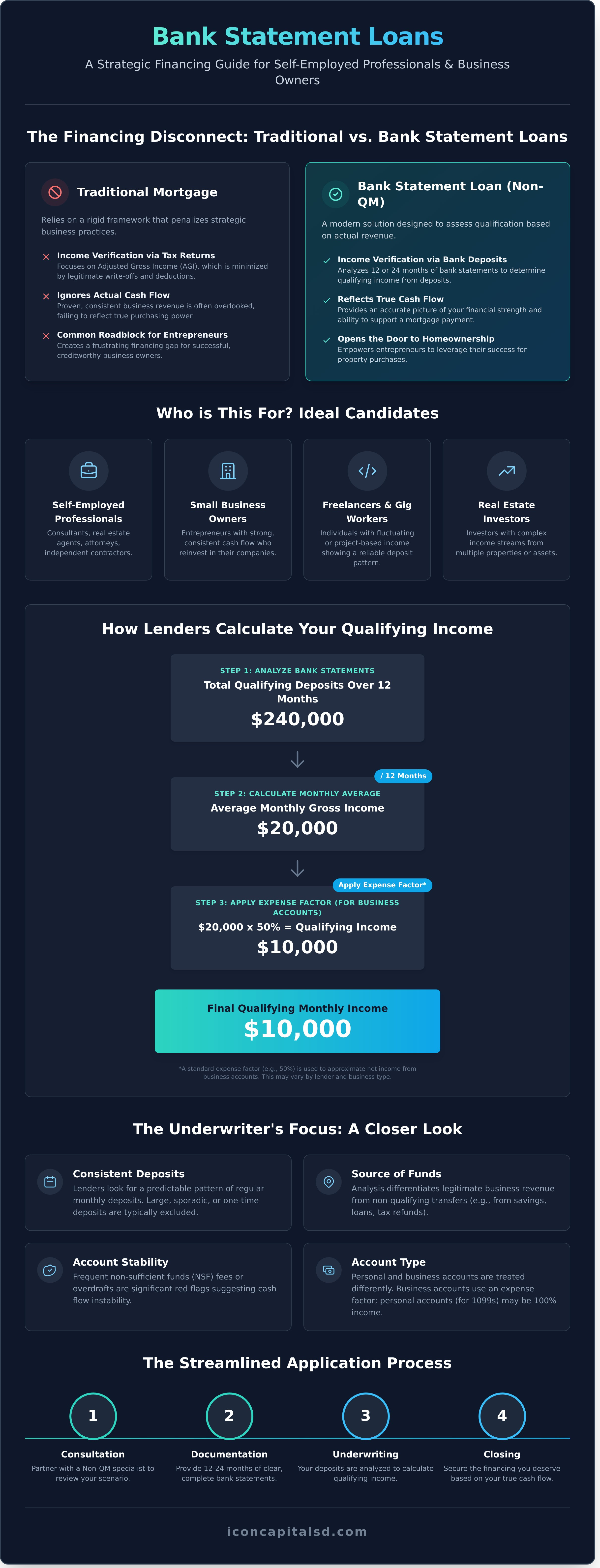
For self-employed borrowers, understanding the income calculation is the most critical step in the mortgage process. Unlike traditional loans that rely on tax returns, bank statement loans use your actual cash flow as the basis for qualification. Lenders will typically analyze either 12 or 24 months of your personal or business bank statements to establish a consistent and predictable gross monthly income.
The underwriter’s primary goal is to verify a stable history of revenue that can reliably support a mortgage payment. This alternative documentation method is a key feature of many non-qualified mortgages, designed specifically for borrowers with non-traditional income streams.
The Underwriting Analysis: What Lenders Look For
An underwriter meticulously reviews your statements to build a clear financial picture. Key areas of focus include:
- Consistent Deposits: Lenders look for a pattern of regular monthly deposits. Sporadic, large, or one-time deposits are typically excluded from the income calculation.
- Source of Funds: The analysis differentiates between legitimate business revenue and non-qualifying transfers, such as funds moved from a savings account, tax refunds, or loans.
- Account Stability: Frequent non-sufficient funds (NSF) fees or overdrafts are significant red flags, suggesting potential cash flow instability.
- Account Type: Personal and business statements are treated differently. Business accounts are assessed with an expense factor to estimate net profit, while personal accounts may be treated as 100% income if the borrower is a 1099 contractor.
A Step-by-Step Income Calculation Example
The calculation is straightforward. First, the lender totals all qualifying deposits over the specified period (12 or 24 months) and divides to find a monthly average. If using a business account, an expense factor is then applied.
- Step 1: Calculate Average Monthly Gross Income
Total Deposits over 12 Months: $240,000
$240,000 / 12 = $20,000 Average Monthly Gross - Step 2: Apply the Expense Factor (for Business Accounts)
A standard expense factor (e.g., 50%) is used to approximate net income.
$20,000 * (1 – 0.50) = $10,000 Qualifying Monthly Income
Preparing Your Statements for a Smooth Application
To ensure an efficient underwriting process, proper preparation is essential. Follow these guidelines in the months leading up to your application for a bank statement loan:
- Avoid Large Cash Deposits: Undocumented cash deposits are difficult to source and may be excluded by the underwriter.
- Eliminate Overdrafts: Maintain a positive balance to demonstrate financial stability.
- Separate Your Finances: If possible, keep business revenue and personal expenses in separate accounts for a cleaner analysis.
- Be Ready to Explain: Prepare to provide a Letter of Explanation (LOX) for any large or unusual transactions.
These practices are much easier to maintain with the right business infrastructure. For example, a modern point-of-sale (POS) system not only processes transactions but also generates clear financial reports that simplify income verification. For business owners evaluating their options, resources from firms like Merchant Solutions Corp can be invaluable in choosing the right tools to support their financial goals.
Bank Statement Loan Requirements: A Clear Checklist
While qualification for bank statement loans is more flexible than for conventional mortgages, lenders still have specific criteria to assess risk and verify your ability to repay. Understanding these requirements is the first step toward preparing a successful application. It is crucial to remember that guidelines vary significantly between lenders and are evaluated on a case-by-case basis.
The core principle of this financing is to use verified cash flow as the primary income source instead of traditional tax documents. As explained in Bankrate’s guide, Bank Statement Loan: What It Is And Who It’s For, this approach is specifically designed for borrowers with non-traditional income streams. Below is a checklist of typical qualification standards to help you determine your eligibility.
Credit Score and Down Payment
Your credit history and the capital you can contribute are key factors in the underwriting decision. Lenders typically look for:
- Minimum Credit Score: Most programs require a FICO score in the mid-600s, with more favorable terms and interest rates often reserved for borrowers with scores of 700 or higher.
- Down Payment: Expect a down payment ranging from 10% to 25%. A larger down payment lowers the loan-to-value (LTV) ratio, reducing the lender’s risk and potentially securing you a better rate. For example, a 20% down payment results in an 80% LTV.
Documentation and Financial Reserves
The primary documentation requirement revolves around your bank statements. To verify your income and financial stability, you will generally need to provide:
- Bank Statements: 12 or 24 months of complete, consecutive personal or business bank statements. All pages are required.
- CPA Letter: Some lenders may request a letter from a certified public accountant (CPA) to confirm your business has been active for at least two years and to verify your expense ratio.
- Financial Reserves: Proof of sufficient assets to cover several months of mortgage payments (including principal, interest, taxes, and insurance) after closing.
- Standard Documents: A copy of your driver’s license, a signed purchase agreement for the property, and other standard application forms.
Property Eligibility and Loan Limits
Bank statement loans are versatile and can be used for various property types, though terms may differ based on the intended use. These programs often accommodate high-value properties, with loan limits frequently extending up to several million dollars. Eligible properties typically include:
- Primary Residences
- Second Homes
- Investment Properties (1-4 units)
Not sure if you qualify? The most effective way to understand your options is to have your specific financial picture reviewed by an expert. Request a free quote to review your scenario with a mortgage professional.
Weighing the Pros and Cons of Bank Statement Loans
Bank statement loans are a powerful financing instrument for self-employed individuals and business owners. However, they are a specialized product, not a one-size-all solution. Understanding the distinct advantages and potential drawbacks is crucial to determining if this is the correct strategic path for your real estate acquisition. This balanced view allows borrowers to make a fully informed decision.
To simplify the comparison, consider the following key points:
| Key Advantages | Potential Disadvantages |
|---|---|
| No Traditional Income Verification: Qualify without W-2s or tax returns, which often fail to reflect the true income of a business owner with significant write-offs. | Higher Interest Rates: To compensate for the alternative documentation, rates are typically higher than those for conventional or government-backed loans. |
| Based on Actual Cash Flow: Your eligibility is determined by the consistent deposits into your business or personal bank accounts, providing a more accurate picture of your financial capacity. | Larger Capital Requirement: Expect a larger down payment, often 20% or more. Lenders will also require significant post-closing cash reserves. |
| Versatile Property Financing: Can be used to purchase primary residences, second homes, and investment properties, offering flexibility for your portfolio. | Specialized Lender Required: Not all banks or mortgage companies offer these programs. You must work with a lender specializing in Non-QM products. |
| Streamlined for Entrepreneurs: The process is often more straightforward for borrowers with complex finances, avoiding the common hurdles of conventional underwriting. | Intensive Statement Review: Underwriters meticulously scrutinize 12 to 24 months of bank statements, analyzing every deposit and transfer for consistency. |
Is This the Right Path for You?
Ultimately, the decision to pursue this type of financing depends on your specific financial profile. If you have strong, consistent cash flow, substantial assets for a down payment, and tax returns that don’t fully capture your purchasing power, bank statement loans can be an extremely effective tool. They provide a direct path to financing that aligns with the realities of running a successful business.
To assess your eligibility and structure the right deal, it is essential to partner with an expert. Explore your options with a specialist at Icon Capital LLC to determine the most effective financing strategy for your goals.
How to Apply: The Process with a Specialized Lender
Traditional lenders often struggle with the variable income streams of self-employed individuals. A specialized lender, however, simplifies the path to financing. At Icon Capital, we have refined the application for bank statement loans into a direct, three-step process designed for maximum efficiency and clarity. Our expertise is in understanding complex financial profiles and structuring loans that align with your specific business and investment objectives.
Our process eliminates ambiguity and focuses on what matters: your actual cash flow.
Step 1: Initial Consultation and Loan Structuring
The process begins with a direct consultation with an Icon Capital loan officer. We will review your financial portfolio, cash flow patterns, and purchasing goals to structure the optimal loan. This initial analysis confirms if this financing is the most effective tool for your scenario and establishes a clear list of the required documentation, ensuring a streamlined submission from the start.
Step 2: Document Submission and Review
Once the loan is structured, you will securely provide your documentation. The primary requirement is your most recent 12 or 24 months of business or personal bank statements. Other necessary items typically include:
- A completed loan application
- A valid government-issued ID
- Statements for any assets (e.g., retirement or brokerage accounts)
Our team performs a thorough initial review to ensure your file is complete and accurately prepared for the underwriter, preventing unnecessary delays.
Step 3: Underwriting, Approval, and Closing
The underwriter conducts a detailed analysis of your bank statements to calculate a consistent, qualifying income based on your deposits. This figure is used to determine your final loan approval. Upon approval, you will receive a formal loan commitment outlining the specific terms and conditions. The final step is coordinating with all parties to proceed to a successful and timely closing on your new property.
Navigating the mortgage process shouldn’t be a barrier to achieving your real estate goals. Our structured approach is designed to provide clarity and deliver results for self-employed buyers and investors.
Ready to begin? Get a personalized quote from Icon Capital.
Secure Your Financing with a Strategic Partner
For self-employed professionals and business owners, traditional income verification is often an unnecessary roadblock to financing. This is precisely where bank statement loans provide a direct path forward, allowing you to qualify for a mortgage based on your business’s actual cash flow, not just your tax-filed income. Lenders analyze 12 to 24 months of deposit history to establish a qualifying income figure. While these non-traditional mortgages offer significant flexibility, success ultimately hinges on a clear understanding of the requirements and partnering with a specialist who navigates this landscape with precision and efficiency.
At Icon Capital, we are specialists in Non-QM and creative financing solutions. Our expertise is in structuring loans specifically for the self-employed and real estate investors who need to move quickly. We’ve designed a direct, efficient process to eliminate delays and provide clear qualification metrics. If you are ready to leverage your true income to secure your next property, we have the tools and experience to get it done. Request a quote to see your loan options and take the decisive next step toward funding your investment.
Frequently Asked Questions About Bank Statement Loans
What is the typical interest rate for a bank statement loan compared to a conventional one?
Interest rates for bank statement loans are typically 1-3% higher than conventional mortgages. This premium reflects the increased risk associated with non-traditional income verification. As a Non-QM product, pricing is determined by factors including your credit score, loan-to-value (LTV) ratio, and overall cash flow strength. Stronger borrower profiles with higher credit scores and lower LTVs will secure the most competitive rates available within this product category.
Can I get a bank statement loan if I have a lower credit score?
Yes, qualification is possible with a lower credit score, though program guidelines vary. Most lenders look for a minimum FICO score between 620 and 660. A lower score will likely result in a higher interest rate, a lower maximum loan-to-value (LTV) ratio, and may require additional compensating factors like significant cash reserves. Borrowers with stronger credit profiles (720+) will access the most favorable terms and highest leverage options.
Are bank statement loans the same as the ‘subprime’ loans of the past?
No, they are fundamentally different. Post-2008 financial regulations introduced strict Ability-to-Repay (ATR) rules that govern all mortgage lending. Unlike old subprime loans, today’s bank statement loans require a thorough analysis of cash flow to verify a borrower’s capacity to service the debt. Underwriters perform a detailed review of deposits to establish a stable, qualifying income, ensuring the loan is a responsible and sustainable financing solution for the borrower.
How many months of bank statements will I need to provide?
The standard requirement is 12 or 24 months of consecutive bank statements. Providing 24 months of documentation typically results in more favorable terms, as it demonstrates a longer history of stable cash flow to the underwriter. Some specialized programs may allow for as few as 3 or 6 months of statements for exceptionally strong borrowers with high credit scores and significant liquid assets, but these are less common and subject to stricter qualification criteria.
Can I use a combination of personal and business bank statements to qualify?
Yes, a combination of personal and business statements can be used to qualify. When using business accounts, lenders will apply an expense ratio to the total deposits to determine the net qualifying income. This ratio may be a standard percentage set by the lender or determined by a profit and loss (P&L) statement from a CPA. Clear documentation is essential to trace the income from the business to the individual for underwriting approval.
How do lenders handle large, one-time deposits on my statements?
Large, one-time deposits that are inconsistent with your typical business cash flow require sourcing and a letter of explanation (LOX). Underwriters must verify these funds are not from an unapproved source, such as an undisclosed loan. Acceptable sources include the sale of an asset or a documented business transaction. Failure to properly source a large deposit may result in it being excluded from the final income calculations used for qualification.
Is it possible to refinance a bank statement loan into a traditional mortgage later?
Yes, refinancing a bank statement loan into a traditional mortgage is a common long-term strategy. To do so, you must meet all requirements for a conventional or government-backed loan. This typically involves establishing a two-year history of income that can be documented via tax returns or W-2s. Once you can prove income through traditional means and meet the credit and equity requirements, you can refinance to potentially secure a lower interest rate.