

For real estate investors, the limitations of traditional financing are a significant barrier to growth. A high personal debt-to-income (DTI) ratio can halt your expansion, while the slow, document-heavy process of a conventional mortgage can cause you to miss timely opportunities. If you need a more efficient way to secure funding based on a property’s cash-flow potential instead of your personal income, the Debt Service Coverage Ratio (DSCR) loan is a powerful alternative designed to help you scale your portfolio quickly.
However, this specialized tool is not a universal solution. A clear understanding of the dscr loan pros and cons is critical before committing to this financing path. While it offers unparalleled speed and flexibility, it also comes with a distinct cost structure and qualification metrics that must be carefully weighed. This article provides a direct, balanced breakdown of the key advantages and disadvantages, empowering you to confidently determine if a DSCR loan is the right strategic move for your next investment acquisition.
Key Takeaways
- Understand how DSCR loans qualify an investment based on its income potential, a key advantage for self-employed investors or those with complex financials.
- Acknowledge the financial trade-offs, including interest rates and down payment requirements, that accompany the flexibility of DSCR financing.
- A clear analysis of the dscr loan pros and cons versus conventional financing helps determine the optimal loan structure for your investment goals.
- Identify the specific scenarios where a DSCR loan provides a strategic advantage and learn how to mitigate its inherent risks for maximum return.
The Pros: Why Investors Choose DSCR Loans
For savvy real estate investors, the DSCR loan is a powerful financing instrument designed for speed and scale. Unlike conventional mortgages that scrutinize personal finances, this loan focuses exclusively on the investment property’s income-generating potential. When evaluating the dscr loan pros and cons, the advantages for portfolio-focused investors are substantial and clear, shifting the qualification from the borrower to the asset itself.
This business-purpose loan allows investors to leverage property performance to secure financing, making it an ideal solution for those who don’t fit the traditional W-2 employee mold.
No Personal Income Verification
The core advantage of a DSCR loan is its underwriting methodology. Lenders qualify the loan based on the property’s ability to cover its own debt service. The primary metric is the property’s Debt Service Coverage Ratio, which simply compares its rental income to its proposed mortgage expenses (PITI). As a result, personal income documents like tax returns, W-2s, and pay stubs are not required. This unlocks financing for self-employed investors, business owners, and individuals with complex or non-traditional income streams.
Accelerated Portfolio Growth
Conventional financing through agencies like Fannie Mae and Freddie Mac typically imposes a limit on the number of properties an individual can finance, often capping at ten. This restriction can severely limit an investor’s ability to scale. DSCR loans remove this barrier entirely. With no formal limit on the number of properties you can finance, this product empowers investors to expand their real estate portfolios efficiently and without arbitrary constraints.
Streamlined and Faster Closing Process
By eliminating the need to document and verify personal income, the DSCR loan process requires significantly less paperwork. This streamlined approach simplifies the underwriting process, leading to much faster approval and closing times. While conventional loans can take 45-60 days or more to close, DSCR loans can often be funded in just a few weeks. This speed provides a critical competitive advantage in active real estate markets where closing quickly can secure the deal.
Flexible Ownership Structures
Serious investors understand the importance of asset protection. A key benefit of the DSCR loan is the ability to hold title in the name of a business entity, such as a Limited Liability Company (LLC) or corporation. This structure provides a crucial liability shield, separating personal assets from your investment portfolio. Many conventional loans require the property to be titled in a personal name, making the DSCR loan a superior choice for building a protected, professional real estate business.
The Cons: Understanding the Financial Trade-Offs
While DSCR loans offer significant flexibility, this convenience comes at a measurable cost. For real estate investors, a clear-eyed assessment of these financial trade-offs is a non-negotiable part of due diligence. Factoring these potential drawbacks into your analysis is critical to ensuring your investment remains profitable and aligns with your portfolio strategy. A complete understanding of dscr loan pros and cons begins with the numbers.
Higher Interest Rates and Fees
DSCR loans are a form of non-qualified mortgage (Non-QM), and lenders price in the additional risk of forgoing personal income verification. Expect interest rates to be approximately 1-3% higher than a comparable conventional investment property loan. Additionally, origination fees and discount points may be more substantial, increasing your total loan costs and impacting your cash-on-cash return calculations.
Larger Down Payment Requirements
Securing a DSCR loan requires more significant upfront capital. Lenders typically mandate a minimum down payment of 20-25%, with some scenarios requiring up to 30%. This is notably higher than the 15% down payment possible with certain conventional investor loans. This higher equity requirement can limit an investor’s ability to scale quickly or preserve liquidity for other opportunities.
Prepayment Penalties are Common
A key structural difference in many DSCR loans is the inclusion of a prepayment penalty. This clause penalizes the borrower for paying off the loan within a specified period, often the first 3-5 years.
- Typical Structure: A common penalty is a “step-down” model, such as 3% of the outstanding balance in year one, 2% in year two, and 1% in year three.
- Strategic Impact: This can create a significant financial barrier for investors utilizing short-term strategies like fix-and-flips or the BRRRR method, which rely on a timely refinance.
Strict Property Eligibility
With a DSCR loan, the property-not the borrower’s income-is the primary focus of underwriting. This means the asset itself must meet stringent criteria. The property must be rent-ready and capable of generating sufficient income to cover the proposed mortgage payment (PITI). The lender calculates the Debt Service Coverage Ratio, and as detailed in Investopedia’s explanation of DSCR, this figure must generally be 1.0x or greater. Consequently, properties requiring extensive renovations that cannot produce immediate rental income will not qualify. A formal appraisal with a rental schedule (Form 1007) is required to validate the income potential.
This strict “rent-ready” requirement makes certain investment strategies a natural fit. For investors aiming to streamline acquisition, it’s often beneficial to explore Turn-Key Investment Properties, as they are specifically prepared to generate immediate cash flow and meet these types of lending criteria.
DSCR vs. Conventional Loans: A Head-to-Head Comparison
Choosing between a DSCR loan and a conventional mortgage is a critical decision for any real estate investor. The optimal choice depends entirely on your investment strategy, financial profile, and the specific property. A direct comparison clarifies the key differences, helping you evaluate the dscr loan pros and cons and align the financing with your long-term portfolio goals. Consider both the immediate and long-term implications before committing to a loan product.
Qualification Basis: Property vs. Borrower
The fundamental distinction lies in the underwriting focus. A conventional loan scrutinizes your personal financial health, primarily your debt-to-income (DTI) ratio. Lenders require extensive proof of personal income to ensure you can cover the mortgage. In contrast, a DSCR loan qualifies the property, not the borrower. The lender’s primary concern is the asset’s ability to generate sufficient cash flow to cover its debt obligations. The underwriting is based on the property’s Net Operating Income (NOI) and its resulting Debt-Service Coverage Ratio. For a deeper analysis of this calculation, see Investopedia’s guide on the Debt-Service Coverage Ratio Explained. This asset-based approach is ideal for self-employed investors or those with complex income streams.
Documentation and Speed
This difference in qualification directly impacts the application process. Conventional loans demand extensive personal financial documents: tax returns, W-2s, pay stubs, and bank statements. This verification process often leads to closing times of 45-60 days or more. DSCR loans streamline this process significantly. Since personal income is not a factor, documentation is minimal-typically requiring a lease agreement and an appraisal. This efficiency translates into a major competitive advantage: faster closing times, often within 21-30 days, allowing investors to seize opportunities quickly.
Cost Structure
The convenience and flexibility of a DSCR loan come at a premium. Investors should analyze these financial trade-offs when weighing the dscr loan pros and cons. Here’s a breakdown:
- Interest Rates: DSCR loans typically have higher interest rates than conforming conventional mortgages to compensate for the different risk profile.
- Down Payment: Expect a larger down payment, usually 20-30%, compared to potentially lower options with some conventional financing programs.
- Prepayment Penalties: Many DSCR products include prepayment penalties, whereas most conventional loans for investment properties do not.
Essentially, the investor is paying for speed, streamlined documentation, and the ability to qualify based on asset performance rather than personal income.
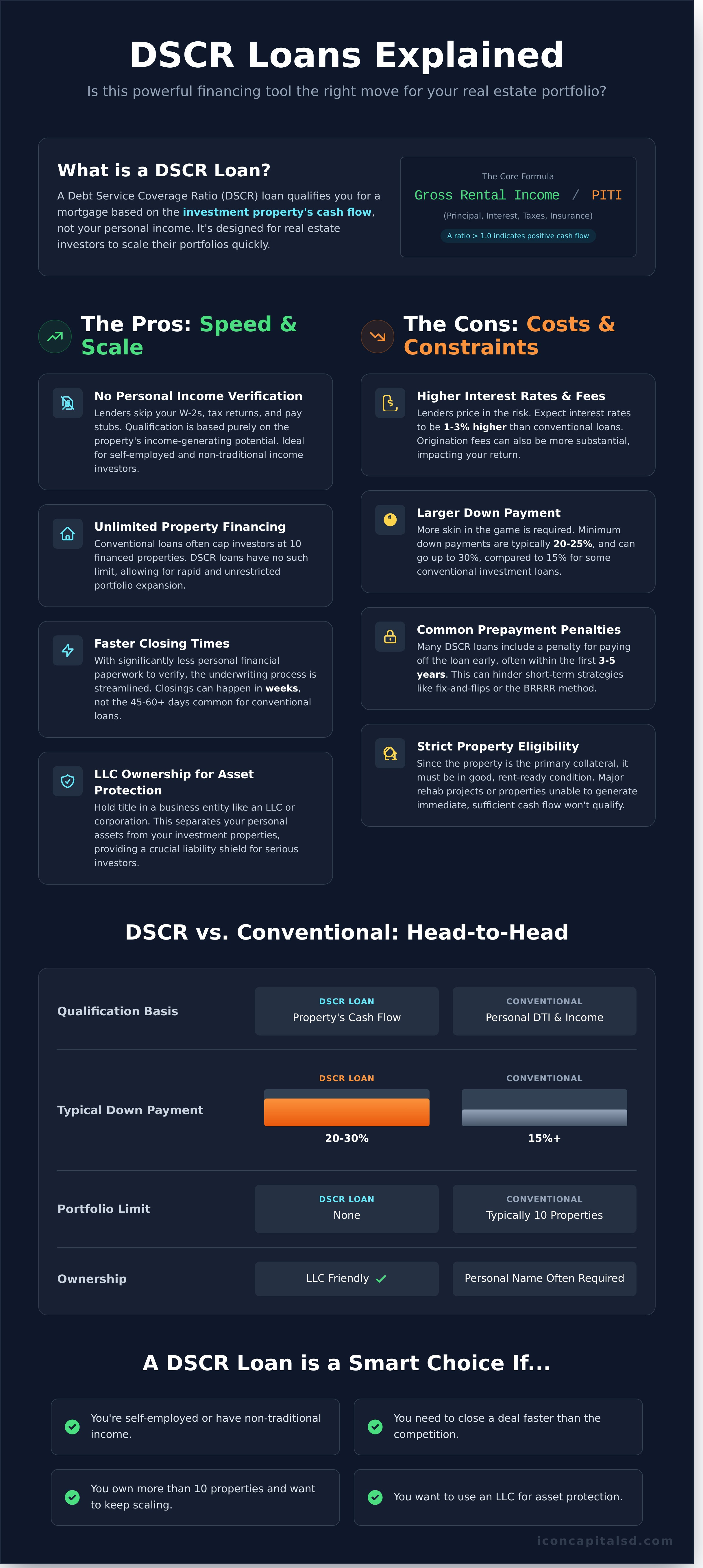
Strategic Analysis: When is a DSCR Loan the Smart Choice?
A DSCR loan is a powerful financial instrument designed for specific investment scenarios. It is not a universal solution, but for the right investor, it provides a decisive advantage where conventional financing creates roadblocks. The key to leveraging this product is understanding how its unique structure aligns with your financial profile and investment goals. Evaluating the dscr loan pros and cons is less about a simple checklist and more about identifying if your strategy matches the scenarios where this loan excels.
The right financing can unlock opportunities that would otherwise be inaccessible. Below are three common investor profiles that benefit significantly from a DSCR loan program.
Profile 1: The Self-Employed Investor
Business owners and entrepreneurs often maximize tax deductions, resulting in a lower adjusted gross income on personal tax returns. This can make qualifying for a conventional mortgage difficult. A DSCR loan bypasses personal income verification entirely, focusing instead on the property’s rental income to cover the debt. The asset, not your tax return, proves its own viability.
Profile 2: The Rapid Portfolio Scaler
For investors looking to scale beyond the conventional 10-property limit imposed by Fannie Mae and Freddie Mac, DSCR loans are essential. Since qualification is property-based, there is no limit to the number of rental units you can acquire. This allows your financing capacity to grow in direct proportion to your portfolio, unhindered by personal debt-to-income (DTI) ratios.
Profile 3: The Investor Needing Speed
In competitive real estate markets, speed is critical. DSCR loans offer a streamlined underwriting process that eliminates the need for personal tax returns, pay stubs, and employment verification. This significantly accelerates closing times, often allowing you to compete with all-cash buyers and secure properties quickly before they are gone. It’s a strategic tool for winning deals in a fast-paced environment.
If your investor profile aligns with these scenarios, a DSCR loan is more than just an alternative-it’s a strategic necessity for growth and agility. To see how these benefits apply to your specific situation, you can explore your financing options with a non-QM specialist.
How to Mitigate the Risks of a DSCR Loan
The potential downsides of a DSCR loan should not be a deterrent for a prepared real estate investor. Instead, they should be viewed as variables to be managed. A strategic approach to financing, underwriting, and asset selection can effectively minimize these risks. Understanding the full spectrum of dscr loan pros and cons allows you to leverage this powerful tool while protecting your portfolio. The key is to plan for the cons, not to be surprised by them.
Partnering with an experienced lender is critical. A skilled loan officer can help you structure a deal that aligns with your property’s performance and your long-term investment goals, ensuring the potential rewards outweigh the calculated risks.
Factor Higher Costs into Your Analysis
DSCR loans typically come with higher interest rates and fees than conventional mortgages. It is essential to build these real-world costs into your financial model from the start. Never use conventional loan assumptions for a DSCR deal analysis. Your projections must confirm the property generates strong positive cash flow after accounting for the higher principal, interest, taxes, and insurance (PITI) payment associated with the DSCR loan.
Align Your Exit Strategy with Prepayment Terms
Prepayment penalties are a common feature of DSCR loans that can impact your profitability if not managed correctly. Your investment strategy must align with the loan’s terms:
- Short-Term Hold: If you plan to sell or refinance within a few years (e.g., a BRRRR strategy), seek a loan with a short penalty period or no prepayment penalty at all.
- Long-Term Hold: For a buy-and-hold investment, a 3 or 5-year prepayment penalty may be acceptable, as it often comes with a more favorable interest rate.
Always confirm the exact penalty structure-whether it’s a percentage of the loan balance or a number of months’ interest-before signing.
Vet Your Property and Rental Market Carefully
Since a DSCR loan relies entirely on property income, the quality of the asset is your primary defense against risk. Thorough due diligence is non-negotiable. Scrutinize local vacancy rates and verify market rents with real-time data, not optimistic projections. Using a conservative rental income estimate provides a crucial buffer in your DSCR calculation, ensuring the property can withstand minor fluctuations in occupancy or rent. Need help analyzing a deal? Request a quote and our experts can assist.
Final Analysis: Leveraging DSCR Loans for Portfolio Growth
The decision to use a DSCR loan hinges on a clear strategic objective. For real estate investors focused on scaling their portfolios, the ability to qualify based on property cash flow rather than personal income is a significant advantage. However, this flexibility requires a calculated approach, as the trade-offs often include higher interest rates and larger down payments. Ultimately, a thorough analysis of the dscr loan pros and cons is essential to determine if this powerful tool aligns with your specific financial goals and the property’s potential.
Navigating these complexities requires an experienced financial partner. As specialists in Non-QM and investor financing, Icon Capital LLC delivers creative financing solutions for even the most complex scenarios. We offer a fast, streamlined loan process built to help you secure assets without delay. When you are ready to determine if a DSCR loan is the right fit for your next acquisition, we are here to provide clarity and structure the ideal financing. Explore your DSCR loan options with Icon Capital LLC today. With the right strategy and a capable lender, you can confidently move forward on your next investment opportunity.
Frequently Asked Questions
What is a good DSCR ratio for a loan?
A DSCR ratio of 1.25 or higher is considered strong by most lenders, as it shows the property’s income is 25% greater than its debt obligations. While some programs may approve loans with a ratio as low as 1.0, a higher DSCR typically results in more favorable terms, such as lower interest rates and higher LTVs. Ratios below 1.0 indicate negative cash flow and will not meet underwriting requirements for most DSCR loan products.
Can I use a DSCR loan for my primary residence?
No, DSCR loans are designated exclusively for non-owner-occupied business-purpose investment properties. Qualification is based on the asset’s income potential, not the borrower’s personal income. Federal regulations prohibit using this type of loan for a primary residence or second home. Investors must use traditional mortgage products like conventional or FHA loans for personal residences, which are underwritten based on personal debt-to-income ratios.
Are DSCR loans available for short-term rentals like Airbnb?
Yes, DSCR loans are widely available for short-term rentals (STRs), including properties on platforms like Airbnb and VRBO. To qualify these properties, underwriters often use projected income data from specialized sources like AirDNA to calculate the DSCR, rather than relying on historical rental income. This structure allows investors to finance properties with strong STR potential, even if they lack a long-term rental history. Specific lender requirements for STRs may apply.
What is the minimum credit score for a DSCR loan?
The minimum credit score for a DSCR loan typically starts around 640, though specific requirements vary by lender and program. To access the most competitive rates and higher loan-to-value (LTV) options, borrowers should aim for a FICO score of 700 or above. A lower credit score may result in a higher interest rate, a lower LTV, or a requirement for a higher DSCR ratio to mitigate the lender’s risk. Strong credit remains a key qualification factor.
Do all DSCR loans have a prepayment penalty?
While not universal, prepayment penalties are a common feature of DSCR loans that protect the lender’s yield if the loan is paid off early. These are often structured on a “step-down” basis, such as 3-2-1 (a 3% penalty in year one, 2% in year two, etc.). Understanding this structure is critical when weighing the dscr loan pros and cons. Many lenders offer options without a prepayment penalty, typically in exchange for a slightly higher interest rate.
Can a first-time real estate investor get a DSCR loan?
Yes, many lenders offer DSCR loans to first-time real estate investors. However, the qualification criteria may be more stringent compared to those for experienced investors. Lenders might require a higher minimum credit score, a larger down payment (lower LTV), and more significant liquid reserves post-closing. Demonstrating strong personal financials and a viable property with a solid DSCR ratio is essential for a first-time investor to secure this type of financing.