

The primary barrier for many real estate investors isn’t locating a profitable property-it’s securing the capital to acquire and renovate it. You’ve seen the term and likely questioned its validity: is a truly zero-down deal possible, or is it just a marketing gimmick? While skepticism is warranted, structuring a deal with minimal cash out-of-pocket is an achievable objective with the right financial strategy. The truth about fix and flip loans no money down is that they are less about a single, magical product and more about a sophisticated financing structure designed to cover 100% of your project costs.
This guide provides a direct, technical breakdown of how 100% financing works in the real world. We will detail the specific qualifications lenders require, from credit scores to deal viability, and outline the actionable strategies investors use to leverage other people’s money for both the purchase and the rehab budget. You will gain a clear understanding of the mechanics behind these loans, enabling you to confidently approach a lender and structure your next investment for maximum leverage and minimal upfront capital.
Key Takeaways
- Understand what “100% financing” truly means-it typically covers the purchase and rehab costs, not all out-of-pocket expenses.
- Lenders mitigate their risk on high-leverage loans by prioritizing experienced investors with strong liquidity and a proven track record.
- Discover the creative structuring strategies investors use to secure true fix and flip loans no money down, often by combining primary and secondary financing.
- Successfully executing a high-leverage flip requires vetting the right lending partner and fully understanding the associated financial risks.
Deconstructing ‘No Money Down’: What 100% Financing Really Means
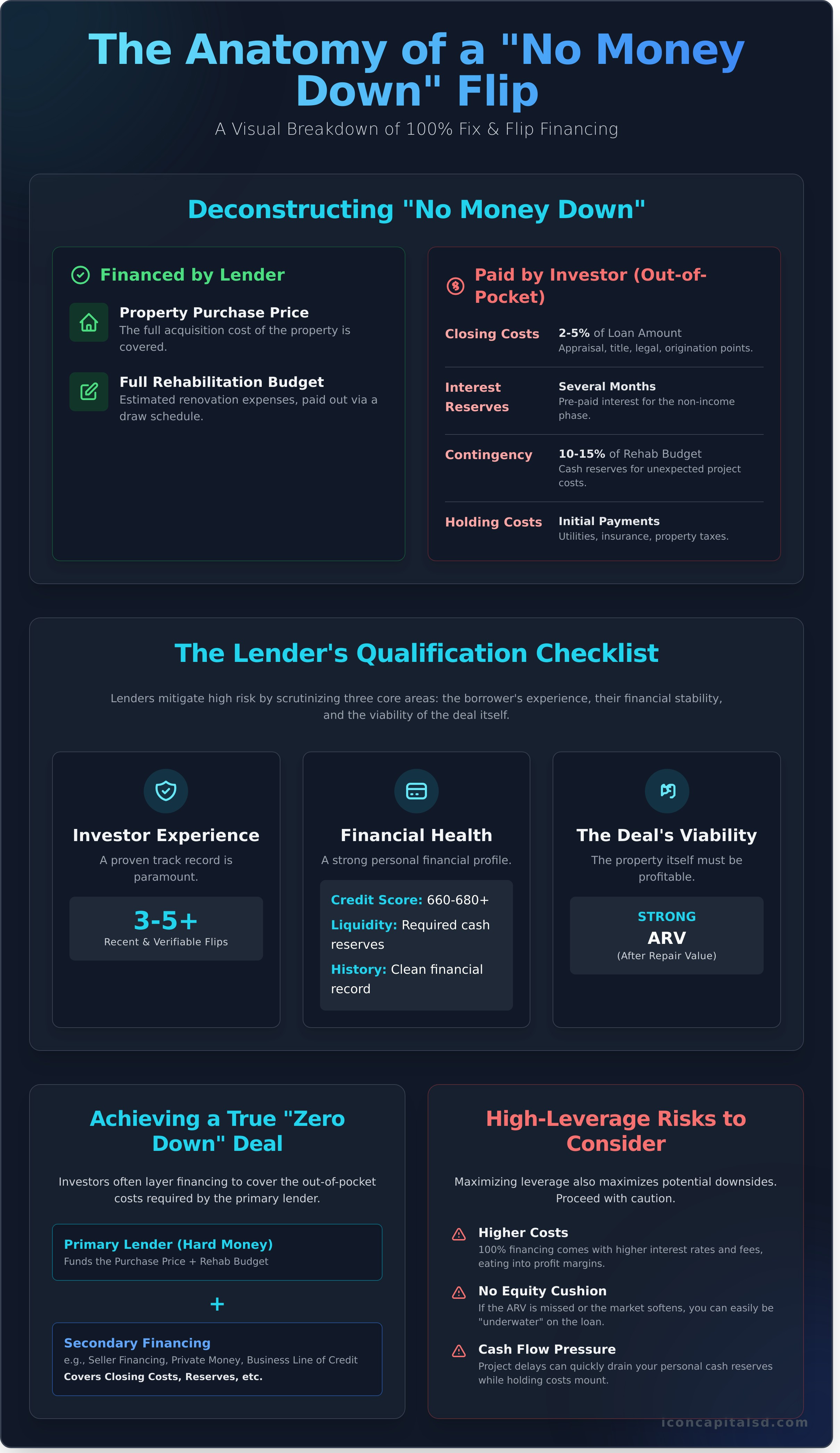
The term “no money down” is a powerful marketing hook, but in the world of real estate investment, it requires careful definition. While it is possible to secure fix and flip loans no money down for the core asset, the phrase is often a misnomer. It does not mean an investor can acquire and renovate a property with zero out-of-pocket cash. Instead, 100% financing typically refers to the lender covering the two largest project costs: the property purchase price and the full rehabilitation budget. This structure allows investors to leverage the lender’s capital for the bulk of the deal, but it is critical to understand which expenses remain the borrower’s responsibility.
Purchase Price & Rehab Budget: The Core of 100% Financing
When a lender offers 100% financing, they are agreeing to fund the property’s acquisition cost plus the estimated renovation expenses. This high-leverage approach is central to the practice of flipping real estate, as it maximizes an investor’s ability to scale. The loan’s approval hinges on a detailed scope of work and the property’s After Repair Value (ARV). The ARV must be sufficient to support the total loan amount, ensuring a profitable exit for the investor and a secure position for the lender. Rehab funds are not disbursed as a lump sum but are paid out through a draw schedule as construction milestones are completed and verified.
The ‘Money Down’ You Still Need: Uncovered Expenses
Even with the purchase and rehab fully financed, investors must bring liquid capital to the closing table to cover several critical expenses. These out-of-pocket costs are standard in nearly every real estate transaction and are not typically included in loan calculations. Being prepared for these ensures a smooth closing and project launch.
- Closing Costs: These include appraisal fees, title insurance, attorney fees, and loan origination points. These can amount to 2-5% of the total loan amount.
- Interest Reserves: Lenders often require the borrower to pre-pay several months of interest payments or hold them in an escrow account. This mitigates the lender’s risk during the non-income-producing renovation phase.
- Contingency Funds: Experienced flippers know to expect the unexpected. Lenders may require proof of cash reserves, typically 10-15% of the rehab budget, to cover unforeseen costs or project overruns.
- Initial Holding Costs: You will be responsible for immediate costs such as setting up utilities, paying for initial insurance premiums (like a builder’s risk policy), and pro-rated property taxes.
Who Qualifies for 100% Fix and Flip Financing? The Lender’s Perspective
From a lender’s standpoint, 100% financing is a high-leverage, high-risk position. To mitigate this exposure, private and hard money lenders apply rigorous underwriting standards that scrutinize both the investor and the underlying asset. Securing fix and flip loans no money down requires a borrower to present a compelling case built on proven experience, financial stability, and a profitable deal structure.
Lenders are not just funding a loan; they are investing in a short-term business venture. As such, they evaluate these key factors to ensure the project’s success and the repayment of their capital.
Your Experience Level Matters
Lenders heavily prioritize investors with a verifiable track record of successful projects. A portfolio showcasing at least 3-5 recently completed flips is often the benchmark for qualification. This documentation should include key metrics for each project: purchase price, renovation budget, final sale price, and net profit. For investors with limited direct experience, partnering with a seasoned professional on the deal can significantly strengthen a loan application and provide the necessary credibility.
Credit Score and Financial Health
A strong personal financial profile is non-negotiable. Key requirements include:
- Credit Score: Lenders typically require a minimum credit score of 660-680, with higher scores improving loan terms and rates.
- Liquidity: Even for a “no money down” loan, you must demonstrate sufficient cash reserves. These funds are needed to cover holding costs, interest payments, and unforeseen expenses during the project.
- Financial History: A clean record free of recent bankruptcies, foreclosures, or significant derogatory marks is a critical qualification factor.
The Quality of the Deal
Ultimately, the viability of the property itself is paramount. The deal must make financial sense on its own merits. Lenders focus intensely on the After Repair Value (ARV)-the estimated market value of the property after all renovations are complete. They analyze the Loan-to-ARV (LTARV) ratio, typically capping it at 70-75% to ensure a sufficient equity cushion. A detailed understanding of how fix and flip loans work reveals the ARV as the core of the lender’s risk assessment. A deal with a substantial projected profit margin, validated by a professional third-party appraisal, demonstrates strong potential and can sometimes offset a borrower’s limited track record.
Creative Strategies to Achieve a True No-Money-Down Flip
Experienced investors understand that securing fix and flip loans no money down is less about finding a single, all-inclusive loan product and more about sophisticated deal structuring. The key is to cover the “gap”-the down payment, closing costs, and initial reserves-that the primary lender doesn’t finance. By strategically combining different capital sources, you can effectively fund 100% of your project costs without using your own cash.
Here are three proven methods used by savvy real estate professionals to structure a zero-money-down deal.
Combining Hard Money with Private Money
This is a common and effective two-loan strategy. A hard money lender provides the primary financing, typically covering up to 90% of the purchase price and 100% of the rehab budget. While hard money is one of the best options for fix and flip loans due to speed, you still need to cover the remaining gap. This is where a private money loan from an individual investor comes in. The hard money lender takes the first lien position, and the private lender secures their smaller loan in a subordinate second lien position.
- Pros: Extremely fast execution, allowing you to compete with cash offers. High degree of flexibility in terms with the private lender.
- Cons: This is an expensive form of capital. The combined interest rates from both loans will significantly impact your profit margin.
Leveraging Seller Financing
In seller financing, the property owner acts as the bank. This strategy works best with motivated sellers, particularly those who own their property outright and are more interested in a steady income stream than a lump-sum payment. You can negotiate for the seller to “carry back” a second mortgage for the amount of the down payment. Your primary hard money or conventional lender takes the first lien position, and the seller takes the second. This powerful technique removes your cash requirement for the down payment entirely.
Structuring a Joint Venture (JV) Partnership
A Joint Venture is a formal partnership on a specific deal. For investors who excel at finding and managing projects but lack capital, this is the ideal structure for fix and flip loans no money down. The partnership typically has two roles:
- The Operating Partner: You find the deal, create the rehab plan, manage the contractors, and oversee the project from start to finish. This is your “sweat equity.”
- The Capital Partner: This partner provides the cash required for the down payment, closing costs, and any holding expenses.
After the property is sold, the capital partner is repaid their initial investment first. Then, the remaining profits are split according to a pre-determined agreement, often 50/50.
Finding and Vetting Your Lending Partner
Once you have a viable deal and a solid strategy, the next critical step is securing financing. It is essential to understand that not all hard money or private lenders offer 100% financing. True fix and flip loans no money down are a specialized product offered by experienced lenders who prioritize the deal’s strength and the borrower’s track record over traditional metrics.
Choosing the right financial partner is as crucial as choosing the right property. Your lender’s efficiency, reliability, and experience directly impact your project’s success and profitability. A substandard lender can delay closing, costing you the deal, or introduce unexpected fees that erode your margins.
What to Look for in a Lender
A quality lending partner for a fix and flip project will exhibit several key characteristics. Your vetting process should focus on identifying lenders who demonstrate:
- Transparency: All points, fees, interest rates, and draw schedules are disclosed upfront. There should be no hidden costs or surprises at the closing table.
- Experience: A proven track record of successfully funding fix and flip projects. An experienced lender understands the nuances of rehab budgets and construction draws.
- Speed and Reliability: The ability to underwrite and close deals quickly. In a competitive market, speed is a significant advantage for acquiring the best properties.
- Flexibility: A willingness to assess deals based on their merit and potential (ARV) rather than relying solely on rigid, traditional lending criteria.
Key Questions to Ask Potential Lenders
Before committing, arm yourself with a list of direct questions to evaluate if a lender’s programs align with your needs. This is not the time for ambiguity; you need concrete data.
- What are your maximum LTV (Loan-to-Cost) and LTARV (Loan-to-After-Repair-Value) for this type of loan?
- What are your standard points, interest rates, and other associated fees?
- What are your minimum requirements for real estate experience and credit score?
- Can you detail your rehab draw process, including inspection requirements and funding timelines?
Preparing Your Loan Application Package
To secure the best terms for fix and flip loans no money down, you must present a professional and comprehensive package. Lenders are funding the deal, but they are betting on you to execute it. Your package should include:
- A fully executed purchase agreement for the property.
- A detailed scope of work and a line-item rehab budget.
- A portfolio of your past real estate projects, showcasing your experience.
- A clear deal analysis with comps supporting your projected After-Repair Value (ARV).
When your package is complete and demonstrates a clear path to profitability, it’s time to request a quote and discuss your deal with a financing specialist.
The Risks and Downsides of High-Leverage Flipping
While the concept of 100% financing is compelling, it’s critical for investors to understand that higher leverage directly corresponds to higher risk. Acknowledging these potential downsides is not meant to discourage, but to equip you for success. Prudent investors analyze every angle of a deal, and the risks associated with fix and flip loans no money down demand careful consideration and strategic planning.
Higher Costs and Lower Profit Margins
Maximum leverage comes at a price. Lenders mitigate their increased risk by charging higher interest rates and more origination points. These increased financing costs directly reduce your net profit at closing. For example, on a $250,000 project, a no-money-down option with higher rates could easily add over $10,000 in financing costs compared to a traditional loan with a 20% down payment, significantly eroding your final profit margin.
The Danger of Over-Leveraging
With little to no personal equity invested, your financial position is more vulnerable to market forces and project delays. Key risks include:
- Market Shifts: If local property values dip, your After-Repair Value (ARV) could fall below your total loan amount, putting you in a negative equity position.
- Default Risk: Without an equity cushion, unexpected carrying costs can strain cash flow, increasing the risk of default and potential foreclosure.
- Refinancing Challenges: Should you need to extend your loan term, refinancing can be difficult or impossible without sufficient equity in the property.
Rehab Budget Overruns
One of the most common deal-killers is an underestimated rehab budget. When using fix and flip loans no money down, you may have no personal cash reserves allocated to the project. An unexpected foundation issue or HVAC replacement can halt all progress. Remember, the lender funds the agreed-upon scope of work and will not typically cover cost overages. It is essential to maintain a separate contingency fund of at least 15-20% of the rehab budget to absorb these surprises and ensure project completion.
Mitigating these risks comes down to meticulous due diligence, conservative budgeting, and having a solid exit strategy. To understand how to best structure your next deal, explore your financing options with an expert.
Navigating High-Leverage Flips: Your Path to Profitability
Ultimately, securing high-leverage financing for your next project is an achievable goal, not a myth. The key takeaways are clear: “100% financing” rarely means zero cash out-of-pocket, and lender approval hinges more on your experience and the deal’s viability than on credit alone. While the allure of fix and flip loans no money down is strong, success demands a strategic approach to cover associated costs and a clear understanding of the inherent risks. The right financial partner is not just a provider of capital; they are a critical component of your investment strategy.
At Icon Capital LLC, we specialize in creative financing solutions for complex real estate investment deals. Our direct and efficient loan process is built for serious investors who require decisive action. Ready to fund your next flip? Request a quote from Icon Capital LLC to explore your financing options. With the right structure, your next profitable flip is within reach.
Frequently Asked Questions About 100% Fix and Flip Financing
What is the minimum credit score for a no-money-down fix and flip loan?
Lenders typically require a minimum credit score of 680, with many preferring 700+ for 100% financing. This higher threshold is due to the increased risk associated with no-money-down loans. Strong credit demonstrates financial responsibility and a history of managing debt, which is a critical factor for underwriters when assessing a borrower’s eligibility for this type of high-leverage financing. A higher score often correlates with more favorable terms and a smoother approval process.
Can a beginner investor get a 100% financing fix and flip loan?
Generally, no. 100% financing is reserved for experienced real estate investors with a proven track record of successful flips. Lenders need to see a portfolio of completed projects-typically 3-5 within the last 24 months-to mitigate their risk. New investors lack this history, making it difficult to qualify for a zero-down program. Beginners should focus on building experience through traditional or low-money-down financing options before pursuing 100% leverage deals.
How are the rehab funds distributed? Do I get all the money at once?
Rehab funds are not disbursed as a lump sum. Instead, they are paid out in draws based on a pre-approved construction budget and schedule. After you complete a phase of work, such as demolition or framing, an inspector verifies the progress. Once approved, the lender releases the funds for that specific portion of the project. This draw system protects the lender’s investment and ensures the capital is used as intended for the renovation.
What are the typical interest rates and points for these types of loans?
Interest rates for 100% financing fix and flip loans typically range from 10% to 13% or higher, reflecting the lender’s increased risk. Additionally, borrowers can expect to pay origination fees, known as points, which usually fall between 2 to 5 percent of the total loan amount. These costs are significantly higher than conventional financing but provide investors with the maximum leverage needed to acquire and renovate a property without using their own capital.
Are there low-money-down fix and flip loans if I can’t qualify for 100% financing?
Yes, numerous low-money-down options exist. Many lenders offer programs that finance up to 90% of the purchase price and 100% of the rehab costs, requiring the borrower to contribute a 10% down payment. These programs are more accessible to investors with less experience than what is required for fix and flip loans no money down. They provide substantial leverage while presenting a lower risk profile to the lender, making them an excellent alternative for scaling a portfolio.
How quickly can I get approved and funded for a no-money-down loan?
The approval and funding timeline is typically faster than traditional mortgages, often closing within 10 to 21 business days. The process speed depends on the lender’s efficiency and the borrower’s ability to provide all necessary documentation promptly. This includes the purchase contract, scope of work, budget, and proof of experience. A well-prepared loan package is critical for an expedited closing and for securing the property quickly in a competitive market.