

For real estate investors, understanding how to get a DSCR loan is the key to scaling a portfolio without relying on personal income. This powerful financing tool qualifies you based on the asset’s cash flow, not your W-2s. However, the path from property identification to closing can feel opaque. You may be questioning the exact application steps, how to accurately calculate the Debt Service Coverage Ratio for a target property, or what specific documentation an underwriter will demand.
This guide eliminates the guesswork. We have distilled the entire process into a direct, five-step framework designed to move your application forward with efficiency and precision. Here, you will find an actionable checklist for loan application, a clear breakdown of lender requirements for credit and reserves, and the confidence to know your property qualifies before you even apply. Consider this your definitive process for securing the financing you need to close the deal.
Key Takeaways
- DSCR loan qualification hinges on the investment property’s cash flow, not the borrower’s personal income.
- While personal income documents are not the focus, a complete borrower profile is essential for an efficient underwriting process.
- Partnering with a specialist lender is critical, as not all financial institutions offer DSCR loan products for investors.
- This guide provides a proven 5-step framework detailing how to get a DSCR loan, from property assessment to closing the deal.
Step 1: Assess Your Investment Property’s Viability
Before approaching a lender, you must first confirm the investment property can qualify for financing on its own merits. Unlike conventional loans that focus on your personal income, a DSCR loan’s success hinges entirely on the property’s cash flow. This initial assessment is the most critical part of understanding how to get a DSCR loan, as it directly impacts your eligibility, loan-to-value (LTV) ratio, and interest rate.
The entire evaluation is based on a single, powerful metric: the Debt Service Coverage Ratio. Your goal is to project realistic income and account for all potential expenses to prove the asset is profitable.
How to Calculate Your Debt Service Coverage Ratio (DSCR)
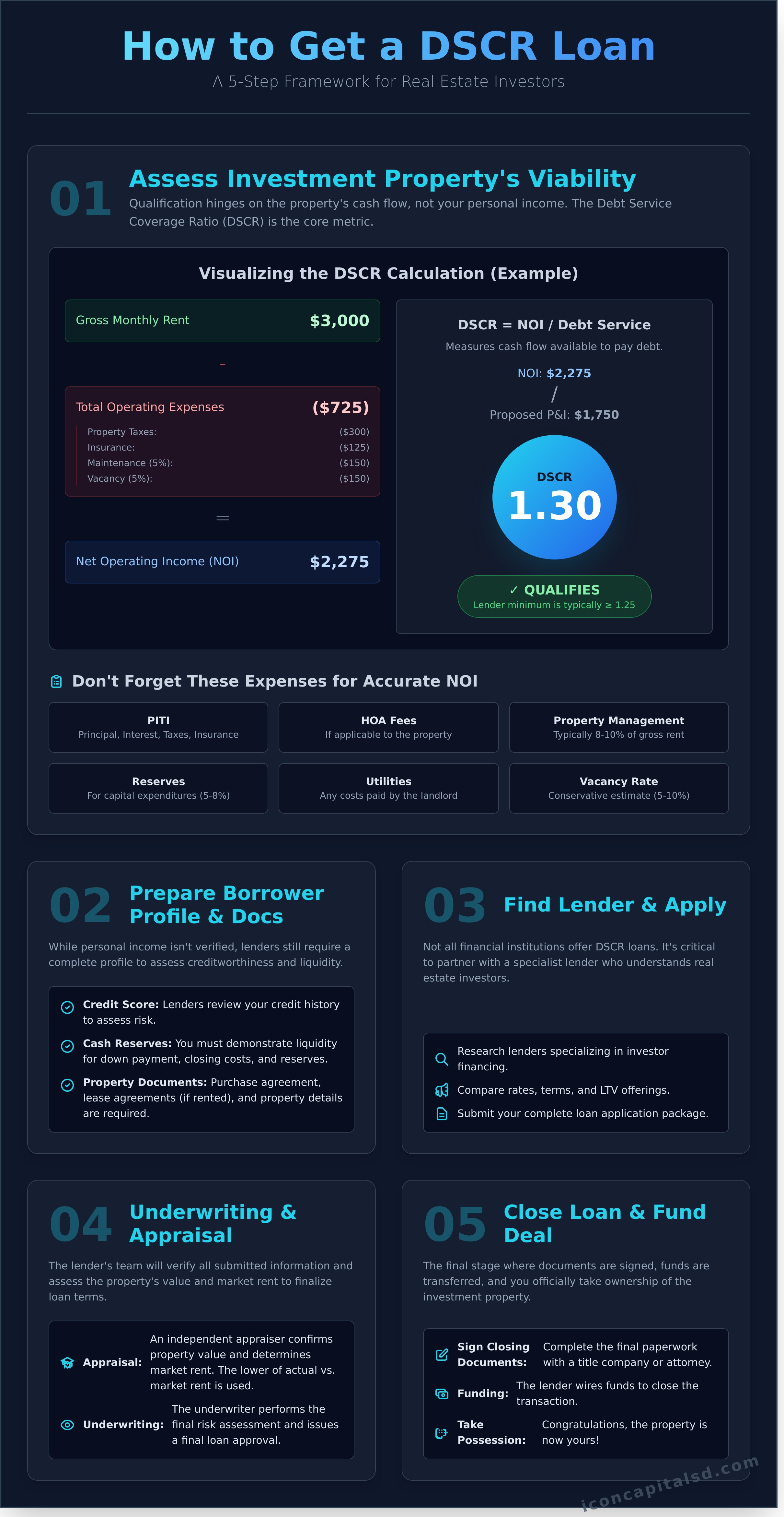
The core of this analysis is the Debt Service Coverage Ratio (DSCR), which measures the property’s cash flow available to pay its debt obligations. The formula is straightforward:
DSCR = Net Operating Income (NOI) / Total Debt Service
To find your NOI, subtract all operating expenses from the property’s gross rental income. Total Debt Service is your proposed monthly loan payment (Principal & Interest). Lenders typically require a DSCR of 1.25 or higher.
.dscr-table {
width: 100%;
max-width: 450px;
border-collapse: collapse;
margin: 1em 0;
font-family: sans-serif;
}
.dscr-table th, .dscr-table td {
border: 1px solid #dddddd;
text-align: left;
padding: 8px;
}
.dscr-table th {
background-color: #f2f2f2;
}
.dscr-table tr.total-row td {
font-weight: bold;
}
| Line Item | Monthly Amount |
|---|---|
| Gross Monthly Rent | $3,000 |
| Less: Operating Expenses | |
| – Property Taxes | ($300) |
| – Insurance | ($125) |
| – Maintenance (5%) | ($150) |
| – Vacancy (5%) | ($150) |
| Net Operating Income (NOI) | $2,275 |
| Proposed P&I Payment | $1,750 |
| DSCR (NOI / P&I) | 1.30 |
Analyzing Market Rents and Vacancy Rates
Your rent projections must be grounded in reality. Use tools like Zillow Rental Manager or Rentometer to verify that your current or projected rent aligns with comparable properties in the area. Lenders will conduct their own appraisal and typically use the lower of the actual rent or the appraiser’s market rent analysis. Always factor in a conservative vacancy rate-typically 5-10%-to account for tenant turnover.
Projecting Property Expenses (PITI and More)
A comprehensive expense list is essential for an accurate NOI and a successful loan application. Go beyond a simple mortgage calculation and include all carrying costs. Your projections must account for:
- PITI: Principal, Interest, Taxes, and Insurance. Use current property tax records and obtain a real insurance quote.
- HOA Fees: If the property is in a homeowners association.
- Property Management: Even if you self-manage, lenders often include a fee of 8-10% of gross rent.
- Reserves: Budget for capital expenditures like a new roof or HVAC system (typically 5-8% of rent).
- Utilities: Include any utilities you are responsible for as the landlord.
Step 2: Prepare Your Borrower Profile and Documentation
While a key benefit of a DSCR loan is the absence of personal income verification, this does not eliminate the need for thorough documentation. Lenders simply shift their focus from your W-2s and tax returns to your creditworthiness, liquidity, and the property’s financial profile. A critical step in understanding how to get a dscr loan is organizing your paperwork to streamline the underwriting process. Lenders will thoroughly review your complete borrower profile and documentation to assess risk and determine loan terms. Having everything in order demonstrates preparedness and expedites funding.
Meeting Credit Score and Cash Reserve Requirements
Your credit score and available cash reserves are significant qualifying factors for a DSCR loan. Most lenders require a minimum FICO score between 620 and 680, though higher scores (720+) typically secure more favorable interest rates and higher LTVs. You must also demonstrate sufficient liquidity for the down payment, closing costs, and cash reserves. Lenders generally require 3-6 months of PITI (Principal, Interest, Taxes, and Insurance) in reserves to ensure you can cover mortgage payments during potential vacancies.
Required Property and Personal Documents Checklist
An organized document package is essential for an efficient closing. While specific requirements vary by lender, a typical submission file includes the following:
- Property Documents: A fully executed purchase agreement, current lease agreements (if applicable), and a recent property appraisal.
- Personal & Entity Documents: A clear copy of your government-issued photo ID, entity formation documents (e.g., LLC Operating Agreement), and two months of recent bank statements to verify funds.
- Financial & Portfolio Documents: Homeowner’s insurance declaration pages, property tax statements, and a detailed schedule of all real estate you currently own (an REO schedule).
Structuring Your Entity (LLC, S-Corp)
DSCR loans are commercial financing instruments, meaning they are almost always made to a business entity rather than an individual. Before applying, ensure your Limited Liability Company (LLC) or S-Corporation is properly formed and in good standing with its state of incorporation. Your operating agreement and articles of organization must be finalized and accessible. This structure is not just a lender requirement; it is a crucial strategy for protecting your personal assets from liabilities associated with your investment properties.
Step 3: Find the Right DSCR Lender and Apply
Once your documentation is organized, the next step is to secure financing. DSCR loans are non-QM products, meaning you will not find them at most traditional banks or credit unions. A critical part of knowing how to get a DSCR loan is selecting a specialist lender with a deep understanding of investment property financing. These lenders focus on asset performance over personal income, resulting in a more streamlined underwriting process designed for real estate investors.
Because the process relies on property cash flow, applications are often processed much faster than conventional loans. Submitting a complete and accurate application package is the best way to prevent unnecessary delays and secure funding efficiently.
What to Look for in a DSCR Loan Specialist
Choosing the right lender is a strategic decision that impacts your portfolio’s profitability. Look beyond the advertised interest rate and evaluate the complete offer. A true specialist will act as a partner, structuring a loan that aligns with your investment goals.
- Experience and Specialization: Does the lender have proven experience with your specific property type, such as short-term rentals, multi-family units, or commercial properties?
- Rates and Fees: Compare interest rates, origination points, processing fees, and, most importantly, prepayment penalty structures.
- Process and Timeline: Inquire about their average closing times and communication protocol. An efficient process is critical in competitive real estate markets.
The Application Process Explained
The application for a DSCR loan typically begins by completing a standard Uniform Residential Loan Application (Form 1003). You will then submit the complete document package prepared in Step 2, and the lender will order a property appraisal, which you are required to pay for upfront. A complete and accurate submission is key to preventing delays in underwriting.
Ready to see your options? Request a quote from Icon Capital LLC.
Understanding the Loan Term Sheet
After a preliminary review, the lender will issue a loan term sheet. This document outlines the proposed loan structure, including the interest rate, loan-to-value (LTV), and loan term. While it is a non-binding offer, it sets clear expectations for the final deal. Review all line-item fees, such as origination, processing, and underwriting costs. Pay close attention to the prepayment penalty clause, as this can significantly affect your exit strategy.
Step 4: Navigating Underwriting and Appraisal
Once your loan application is submitted, it moves to the underwriting and appraisal phase. This is the lender’s formal due diligence process, where all information is verified and the property’s value and income potential are professionally assessed. Unlike conventional loans, the underwriter’s primary focus is on the asset’s cash flow, not your personal income.
Success in this stage hinges on the property’s numbers and your ability to respond quickly to requests. This is the final verification step before your loan is cleared to close.
What the Underwriter Focuses On
The underwriter acts as the lender’s risk analyst. Their job is to validate every component of the loan file to ensure it meets specific guidelines. For a DSCR loan, their review centers on:
- DSCR Calculation: Independently verifying the property’s gross rental income and PITI to confirm it meets the required DSCR threshold (typically 1.0x or higher).
- Source of Funds: Confirming you have sufficient and legitimate funds for the down payment, closing costs, and required cash reserves.
- Credit and Experience: Reviewing your credit report for major derogatory events and assessing your experience as a real estate investor.
- Title Report: Ensuring the property has a clear title, free of any unexpected liens or encumbrances that could jeopardize the lender’s position.
The DSCR Appraisal: What’s Different?
The appraisal is one of the most critical components in this process. While it establishes the property’s market value, a DSCR appraisal includes a crucial extra step: the appraiser must complete a Comparable Rent Schedule (Form 1007). This report analyzes rental rates for similar properties in the area to establish an independent, market-based opinion of the property’s income potential. This figure-not your projected rent-is what the underwriter uses for the final DSCR calculation. Understanding this distinction is fundamental to knowing how to get a dscr loan approved.
Common Hurdles and How to Overcome Them
Navigating the final steps of how to get a dscr loan involves preparing for potential obstacles. Here are common issues and their solutions:
- Low Appraisal Value: If the property appraises for less than the purchase price, it will impact your maximum loan-to-value (LTV). The solution is typically to increase your down payment to cover the difference.
- Low Market Rent Analysis: If the appraiser’s rent schedule is lower than expected and jeopardizes your DSCR, you can provide the lender with your own data on comparable local rentals to challenge the finding.
- Title Issues: A lien or judgment on the title report can halt the process. Work proactively with the title company and your loan officer to resolve any issues immediately.
- Document Requests: Underwriters often issue requests for additional information (known as “conditions”). Responding promptly and completely is essential to avoid delays.
At Icon Capital, our expertise lies in anticipating these requirements and guiding investors through a streamlined underwriting process.
Step 5: Closing Your Loan and Funding the Deal
The final stage of the DSCR loan process involves executing legal documents and transferring funds to complete your real estate investment purchase. Once your file has cleared underwriting, your lender will issue a “Clear to Close” (CTC), signaling that all conditions have been met. At this point, the focus shifts to a final review of all figures before signing. Funding typically occurs within 24 to 48 hours of closing.
Reviewing the Closing Disclosure (CD)
By law, you must receive your Closing Disclosure (CD) at least three business days before your scheduled closing. This document finalizes all figures for your loan. Compare it directly against your initial Loan Estimate to identify any discrepancies. Pay close attention to the critical details:
- Loan Amount: Verify it matches the agreed-upon financing.
- Interest Rate & Monthly Payment: Confirm these core terms are accurate.
- Closing Costs: Check all lender and third-party fees.
- Cash-to-Close: Know the exact amount you must bring to closing.
What to Expect on Closing Day
Closing typically takes place at the office of a title company or real estate attorney. Arrive prepared with a government-issued photo ID and the required funds, usually in the form of a cashier’s check or a confirmed wire transfer. You will sign a series of legal documents, including the promissory note and the mortgage or deed of trust. Executing these documents officially completes the process of how to get a dscr loan and makes the transaction legally binding.
Post-Closing: Managing Your New Loan
With the deal funded, your responsibility shifts to loan and property management. You will soon receive your first mortgage statement and instructions for setting up recurring payments. Securely file all your closing documents for future reference. Now, you can focus on managing your investment property to ensure it generates the positive cash flow needed to service the debt. As your portfolio grows, plan your next investment and get a pre-approval quote to stay ahead.
Execute Your DSCR Loan Strategy
Securing a DSCR loan is a direct path to leveraging your investment property’s cash flow for financing. The process hinges on two critical factors: a strong Debt Service Coverage Ratio from your property and a well-prepared borrower profile with all necessary documentation. Mastering these elements is the core of how to get a DSCR loan, transforming a complex process into a manageable series of steps focused on asset performance rather than personal income.
When you are ready to proceed, partnering with the right lender is key. Icon Capital provides creative financing solutions for real estate investors. As specialists in Non-QM and asset-based lending, we utilize a streamlined process designed for speed and efficiency, removing unnecessary hurdles so you can focus on your portfolio. Let our expertise simplify your next acquisition. Start your DSCR loan application with a specialist today.
Take the next step to expand your real estate portfolio with confidence.
Frequently Asked Questions
What is the minimum DSCR ratio lenders usually require?
Most lenders require a minimum DSCR of 1.25, meaning the property’s gross rental income must be at least 25% greater than its total mortgage payment (PITI). While some programs may accept a ratio as low as 1.0 for highly qualified borrowers or specific loan structures, a higher ratio of 1.50 or more typically results in more favorable terms. This includes access to lower interest rates and higher loan-to-value (LTV) allowances from the underwriter.
Can I get a DSCR loan for a short-term rental property like an Airbnb?
Yes, DSCR loans are specifically designed for financing both long-term and short-term rental properties. For properties like an Airbnb or VRBO, lenders underwrite the loan using projected income data from specialized services like AirDNA rather than a traditional lease agreement. This allows investors to qualify based on the property’s high-income potential as a vacation rental, making it an ideal financing solution for this asset class and enabling portfolio growth in the short-term rental market.
How is a DSCR loan different from a conventional investment property loan?
The primary difference is the qualification basis. A conventional loan underwrites the borrower, focusing on personal income and debt-to-income (DTI) ratios. A DSCR loan underwrites the property, qualifying it based on its ability to generate sufficient cash flow to cover the mortgage payments. This asset-based approach means personal income documentation is not required, which simplifies how to get a DSCR loan and allows investors to scale their portfolios without impacting their personal DTI.
Are there prepayment penalties on all DSCR loans?
Prepayment penalties are common with DSCR loans but are not a feature of every product. Many lenders utilize a step-down penalty structure, such as a “3-2-1” model, where the fee is 3% of the balance if paid off in year one, 2% in year two, and 1% in year three. This structure is a trade-off for the flexible qualification standards. Borrowers can often negotiate terms or select a loan product with no prepayment penalty, sometimes in exchange for a slightly higher interest rate.
How quickly can you close on a DSCR loan compared to a traditional mortgage?
DSCR loans typically close significantly faster than traditional mortgages. The streamlined documentation process, which omits personal tax returns and W-2s, accelerates the underwriting timeline. While a conventional loan often takes 30-45 days to close, a DSCR loan can frequently be funded in as little as 15-25 business days. This speed provides a critical competitive advantage for investors who need to close on properties quickly in a competitive market environment.
Can I get a DSCR loan if I have no other real estate investing experience?
Yes, first-time real estate investors can qualify for a DSCR loan. However, lenders may implement stricter guidelines for new investors to mitigate risk. These can include requiring a higher minimum credit score (e.g., 700+), a larger down payment resulting in a lower LTV, and a stronger DSCR ratio on the subject property. Demonstrating significant liquid reserves can also strengthen a first-time investor’s application and improve the likelihood of approval.