

Investing in the U.S. real estate market from abroad presents a significant opportunity, yet many international investors are stopped by perceived barriers. The lack of a U.S. credit score, the absence of a Social Security Number, and the complexity of verifying foreign income can make the process seem impenetrable. The solution is a specialized financial product designed specifically for this scenario: the foreign national loan.
This definitive guide is engineered to demystify the entire process. We provide a direct breakdown of eligibility criteria, a complete checklist of required documentation for verifying international assets, and a step-by-step roadmap to securing your investment property. Our objective is to replace financial uncertainty with a clear, actionable strategy.
By the end of this article, you will have the necessary information to confidently navigate the application and secure the financing required to build your U.S. real estate portfolio. The goal of U.S. property ownership is not only achievable-it is a structured process you can master.
Key Takeaways
- Understand the core qualification pillars, which prioritize asset verification and the investment property’s potential over traditional U.S. credit metrics.
- Navigate the application with a clear, step-by-step roadmap that simplifies the process from initial documentation to closing on your U.S. property.
- Discover the typical structures and terms available for a foreign national loan, including eligible property types from single-family rentals to multi-unit buildings.
- Learn why partnering with a specialist lender is critical for structuring complex deals and avoiding common pitfalls associated with traditional financing.
What Is a Foreign National Loan?
A foreign national loan is a specialized mortgage product designed for non-U.S. citizens seeking to purchase real estate within the United States. Its primary purpose is to finance investment properties or second homes, providing a direct path for global investors to enter the lucrative U.S. property market. This financing vehicle is a critical tool for building an international real estate portfolio.
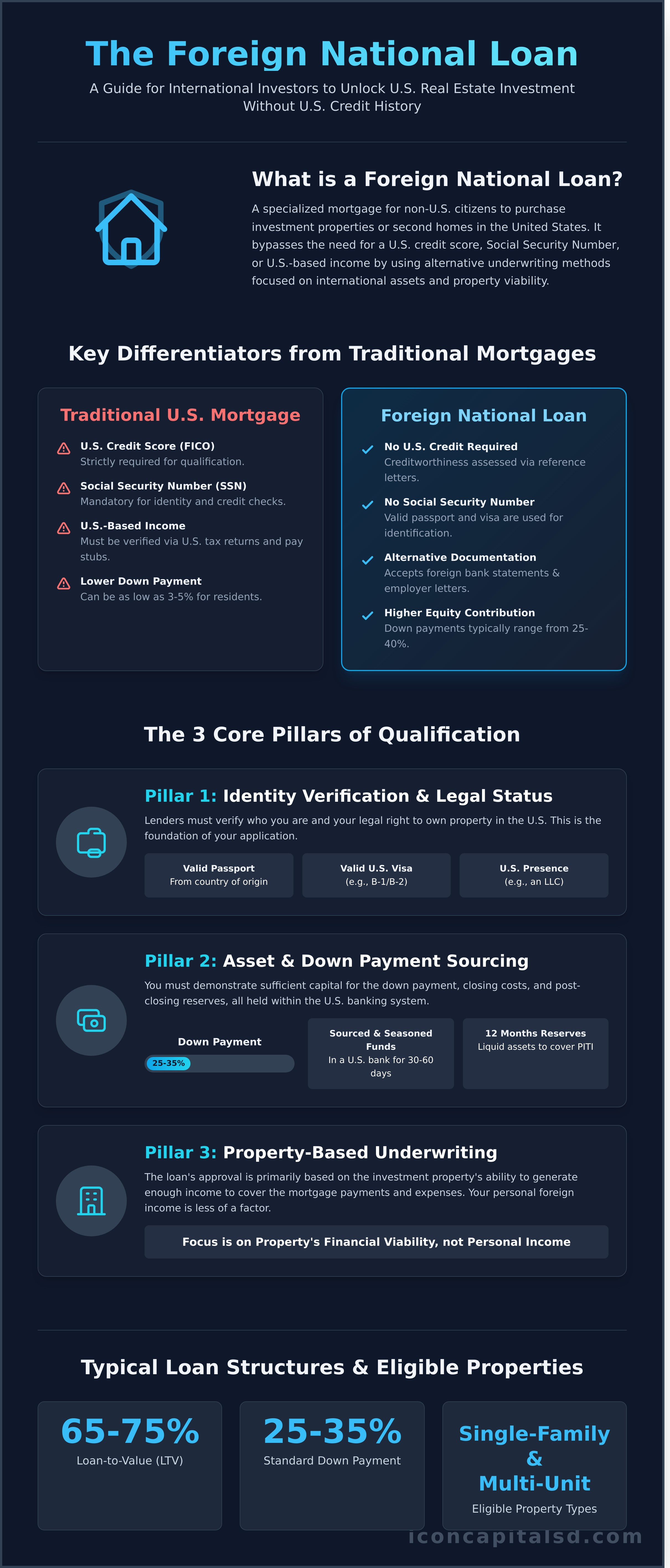
Unlike conventional mortgages, which require U.S. credit history, a Social Security Number (SSN), and verifiable U.S.-based income, this product is structured for individuals whose financial footprint is primarily outside the United States. A Foreign National Mortgage bypasses these traditional requirements by using alternative methods of underwriting and risk assessment, making U.S. real estate investment accessible to a broader range of qualified international buyers.
Defining the ‘Foreign National’ Borrower
The typical borrower for a foreign national loan is a non-resident alien who does not hold a green card and does not permanently reside in the U.S. These individuals live and work in their country of origin and are often purchasing property for investment diversification or personal use during temporary visits. Qualification is generally open to those with valid visas, such as a B-1/B-2 visitor visa, or citizens of countries participating in the Visa Waiver Program.
Many of these investors seek to diversify their portfolios across different geographies and asset classes. For instance, those looking for opportunities within Europe might explore an Italian private equity marketplace to complement their real estate holdings.
This global perspective extends beyond financial assets. Understanding the engines of international trade, such as the logistics facilitated by entities like Adimar Shipping, Inc., can provide valuable insights into the economic trends that drive real estate markets.
Key Differentiators from Traditional U.S. Mortgages
This financing instrument operates under a different set of rules compared to standard U.S. home loans. The structure is specifically designed to accommodate the unique financial circumstances of international investors. Key differences include:
- No U.S. Credit Required: Lenders do not require a FICO score or U.S. credit history. Instead, they may assess creditworthiness through letters of reference from the borrower’s home-country financial institutions.
- Alternative Documentation: Income and asset verification are flexible. Documentation may include statements from foreign banks, letters from foreign employers, or reports from an accountant in the borrower’s home country.
- Higher Equity Contribution: Down payments are typically higher, often ranging from 25% to 40% of the purchase price. Lenders also require significant post-closing liquidity, or reserves, held in a U.S. bank account.
- Use of U.S. Entities: For liability protection and to simplify the transaction, the loan is frequently made to a U.S.-based entity, such as a Limited Liability Company (LLC), established by the foreign national borrower.
Core Qualification and Eligibility Requirements
Securing a foreign national loan is a streamlined process when you understand the core pillars of qualification. Unlike traditional mortgages that heavily scrutinize U.S. credit history and income, Non-QM lenders focus on three key areas: verifiable identity, sufficient assets, and the investment property’s financial viability. This pragmatic approach is designed for the specific needs of international real estate investors, setting clear expectations for documentation and financial standing.
Identity Verification and Legal Status
Lenders must verify your identity and legal right to own property in the United States. This requires clear documentation and a U.S. point of contact. Understanding U.S. tax regulations, such as the Foreign Investment in Real Property Tax Act (FIRPTA), is also a critical component of establishing your legal and financial standing. Key documentation includes:
- Valid Passport: A clear, unexpired passport from your country of origin.
- Valid U.S. Visa: A B-1/B-2 tourist visa is commonly accepted for this purpose.
- U.S. Presence: A U.S. mailing address or registered agent is required. Many investors satisfy this by closing the transaction within a U.S. Limited Liability Company (LLC).
Asset and Down Payment Sourcing
Demonstrating sufficient capital is a primary requirement. Lenders need to see that you have the funds for the down payment and post-closing reserves, sourced and seasoned within the U.S. financial system.
- Down Payment: A typical loan-to-value (LTV) is 65-75%, which translates to a standard down payment of 25-35%.
- Sourced and Seasoned Funds: Your down payment and closing costs must be held in an FDIC-insured U.S. bank account for at least 30-60 days before closing.
- Financial Reserves: Lenders typically require you to hold 12 months of total mortgage payments (PITI) in liquid assets after the loan closes.
Property-Based Underwriting: The DSCR Approach
The most significant advantage of a modern foreign national loan is its underwriting method. Instead of analyzing personal income, we qualify the loan based on the property’s ability to generate cash flow. This is known as the Debt-Service Coverage Ratio (DSCR) approach. The DSCR is calculated by dividing the property’s gross rental income by its mortgage expenses (Principal, Interest, Taxes, and Insurance – PITI). If the property’s income covers or exceeds its expenses, it generally qualifies, making it an ideal solution for real estate investors.
The Foreign National Loan Application Process: A Step-by-Step Guide
Securing a foreign national loan is a structured process designed for efficiency. While navigating U.S. real estate financing from abroad may seem complex, working with a specialist lender simplifies it into a clear, four-step pathway from initial inquiry to closing. This guide demystifies each stage for the international investor.
Step 1: Lender Consultation and Loan Structuring
The process begins with a direct consultation. Choosing a lender with deep expertise in Non-QM and foreign national financing is critical. During this initial call, we discuss your investment objectives, the target property type, and your financial position. Based on this, we structure the optimal loan and provide a detailed term sheet outlining rates and conditions. To start this process, you can request a quote to explore your options.
Step 2: Document Submission and File Opening
Once the loan is structured, we open your file and begin collecting necessary documentation. These documents are uploaded through a secure portal and are essential for verifying identity and financial capacity, helping to satisfy the complex legal and regulatory requirements for foreign national loans. A typical checklist includes:
- Valid Passport and U.S. Visa (if applicable)
- Recent U.S. bank statements showing sufficient funds for down payment and reserves
- Signed purchase and sale agreement for the property
- Formation documents for the U.S. entity (e.g., LLC Operating Agreement), if purchasing through one
Step 3: Underwriting and Property Appraisal
With a complete file, our underwriting team begins its review. This stage involves verifying all submitted information and ordering an independent, third-party appraisal to confirm the property’s market value. For investment properties, the underwriter’s primary focus is ensuring the property’s projected income meets the Debt Service Coverage Ratio (DSCR) required by the specific foreign national loan program.
Step 4: Approval and Closing
Upon successful underwriting and appraisal review, a ‘Clear to Close’ (CTC) is issued. This is the official loan approval. From here, our team coordinates with a U.S.-based title and escrow company to prepare closing documents and schedule the final signing. Once funds are wired and all documents are executed, the title is transferred, and you officially own the U.S. investment property.
Common Loan Structures and Eligible Properties
Understanding the available financing structures and property eligibility is critical for any international investor. A foreign national loan is specifically designed to facilitate investment in U.S. real estate, but it comes with distinct parameters regarding terms, rates, and the types of assets that can be financed. These products are engineered for efficiency and performance, focusing on the asset’s income potential rather than the borrower’s U.S. credit history.
Typical Loan Terms and Rates
While terms can be customized, most foreign national financing programs follow a predictable structure. The goal is to provide stable, long-term financing that supports an investor’s portfolio goals. Key features typically include:
- Loan Programs: Investors can access 30-year fixed-rate mortgages for predictable payments or Adjustable-Rate Mortgages (ARMs), such as a 5/6 or 7/6 ARM, for initial lower rates.
- Interest Rates: Expect interest rates to be slightly higher than conventional loans available to U.S. citizens. This premium reflects the lender’s additional risk.
- Pre-Payment Penalties: A significant advantage of many programs is the absence of pre-payment penalties, offering investors the flexibility to sell or refinance the property without incurring extra fees.
Eligible Investment Property Types
Financing is available for a range of residential investment properties. These loans are exclusively for non-owner occupied assets intended to generate rental income or appreciate in value. Primary residences or vacation homes for personal use are not eligible.
Commonly financed properties include:
- Single-Family Residences (SFRs)
- 2-4 Unit Properties
- Warrantable Condominiums
- Planned Unit Developments (PUDs) and Townhomes
While not always mandatory, holding the property title in a U.S. entity, such as a Limited Liability Company (LLC), is a standard and highly recommended practice. This structure provides critical liability protection, separating personal assets from investment assets, and can streamline the transaction and management process. For a detailed assessment of financing structures for your specific investment strategy, we invite you to explore our loan programs.
Why Partner With a Specialist for Foreign National Loans
Securing a U.S. real estate investment loan as a non-resident presents unique challenges. While large, traditional banks may offer a wide array of services, they often lack the specialized knowledge required for international financing. Their rigid underwriting criteria and unfamiliarity with foreign documentation can lead to significant delays and, ultimately, loan denial. A specialist lender, by contrast, operates exclusively within this complex space, providing the expertise necessary to navigate the process efficiently.
Partnering with an expert in non-resident financing provides a distinct competitive edge. The primary advantages are clear:
- Unmatched Expertise: Specialists possess a deep understanding of the compliance and documentation hurdles specific to a foreign national loan, from international asset verification to navigating visa requirements.
- Greater Efficiency: A focused approach means streamlined processes designed to avoid the common pitfalls that stall applications at conventional institutions.
- Creative Solutions: Unlike traditional banks, specialist lenders are structured to provide flexible and creative financing tailored to the unique circumstances of international investors.
Navigating Complexity with Expert Guidance
Foreign national lending involves a level of due diligence that goes far beyond standard domestic mortgages. Specialists understand the nuances of verifying assets held in foreign banks, interpreting international credit histories, and complying with U.S. regulations like the Bank Secrecy Act. This expertise allows investors to avoid common rejections and secure financing with confidence. By working with a dedicated partner, you bypass the learning curve and institutional friction inherent in large, generalized banks.
The Icon Capital LLC Advantage: Speed and Simplicity
At Icon Capital LLC, we are built to serve the modern real estate investor. Our entire process is engineered for clarity and speed, removing the barriers that typically complicate cross-border transactions. Our focus on Debt-Service Coverage Ratio (DSCR) underwriting allows us to qualify your loan based on the property’s income potential, eliminating the need for complex foreign income verification. We specialize in structuring creative financing for unique investor situations, ensuring you have the capital needed to scale your portfolio. Our streamlined four-step process is designed for maximum efficiency, moving your deal from submission to closing without unnecessary delays. Request a quote from our experts today to finance your U.S. property.
Unlock U.S. Real Estate with the Right Financing Partner
Investing in U.S. real estate from abroad is an achievable goal for serious international investors. This guide has outlined the core qualification requirements and application process, providing a clear path to securing property. The most critical takeaway is that success hinges on navigating the specific complexities of a foreign national loan, a task best handled by a dedicated specialist who understands the market and the financing structures required.
At Icon Capital LLC, we are specialists in Non-QM and creative financing. We provide expert guidance for international clients, leveraging streamlined, DSCR-based programs designed to facilitate portfolio growth. Our direct, efficient approach removes unnecessary barriers, allowing you to focus on the investment itself.
Ready to take the next step? Request a Quote to Explore Your Financing Options and let our team structure the ideal loan for your U.S. property acquisition. The opportunities in the U.S. market are significant, and with the right financial partner, they are well within your reach.
Frequently Asked Questions About Foreign National Loans
Do I need a U.S. credit score to get a foreign national loan?
No, a U.S. credit score is not a prerequisite for a foreign national loan. Lenders utilize alternative methods to assess creditworthiness, including international credit reports or professional reference letters from the applicant’s foreign banking and credit relationships. The underwriting focus is on verifying a strong financial history and the capacity to repay the debt, making these programs accessible to investors without an established U.S. credit file. This flexibility is a core feature of this financing.
What is the minimum down payment required for a foreign national mortgage?
The minimum down payment for a foreign national mortgage is typically higher than for conventional loans, generally starting at 25% to 30% of the purchase price. The exact Loan-to-Value (LTV) ratio required depends on factors including the property type, loan amount, and the borrower’s overall financial profile. Lenders require this higher equity position to mitigate the risks associated with cross-border lending and asset management, ensuring a secure investment for all parties.
Can I get a foreign national loan for a primary residence I will live in?
Generally, these loan programs are designed for purchasing second homes or investment properties, not for a primary residence. The underwriting assumption is that the borrower maintains their primary residence outside of the United States. These products are structured specifically to facilitate U.S. real estate investment for non-resident aliens. Borrowers intending to occupy the property as a main home would likely need to qualify under different programs that accommodate resident alien status.
How long does the entire foreign national loan process typically take from start to finish?
The typical timeline for a foreign national loan, from a complete application to closing, is approximately 45 to 60 days. This timeframe is often longer than a standard domestic mortgage due to the additional due diligence required. The process involves verifying foreign-sourced income, assets, and identity documentation, which can be time-intensive. Providing all requested international paperwork promptly is critical for the borrower to keep the process moving efficiently through underwriting.
Are gift funds from a family member allowed for the down payment?
Yes, gift funds are generally permitted for a portion of the down payment but are subject to strict documentation requirements. The lender will require a signed gift letter from the donor confirming the funds are a true gift with no expectation of repayment. Additionally, you must provide bank statements to verify the source and transfer of the funds. Note that borrowers are typically still required to contribute a minimum percentage of the down payment from their own seasoned assets.
What specific U.S. visa types are generally eligible for these loan programs?
Eligibility is not always contingent on a specific visa. For investment properties, many programs do not require a visa at all. For second homes, common eligible non-immigrant visas include B-1/B-2 (Business/Tourism), H-1B (Specialty Occupation), L-1 (Intracompany Transfer), and E-2 (Treaty Investor). Since qualification criteria vary significantly between lenders, it is essential to confirm which visa statuses, if any, are required for a specific loan product you are targeting.
Is it better to purchase the property as an individual or through a U.S. LLC?
Purchasing property through a U.S. Limited Liability Company (LLC) can offer significant liability protection and potential tax advantages for a foreign investor. However, financing a property held in an LLC may be structured as a commercial loan, which can result in a higher interest rate or different terms compared to a loan made to an individual. We strongly recommend consulting with qualified legal and tax advisors to determine the optimal ownership structure for your specific investment goals.