

Securing U.S. real estate financing without a domestic credit history or Social Security Number presents a significant challenge. For many, the assumption is that foreign-based income or a specific visa status are automatic disqualifiers for a mortgage. This is a common but critical misconception. The primary barrier is not ineligibility, but a lack of familiarity with lenders and products structured for non-traditional financial profiles. This is why understanding the specific landscape of loans for immigrants is essential for success.
This guide provides a direct, actionable framework for navigating the U.S. mortgage process. We will detail the exact eligibility requirements, documentation needs, and loan options available to you, regardless of your U.S. credit footprint. You will gain a clear path to leveraging your unique financial situation to acquire investment properties or a new home, ensuring you partner with a lender who understands the mechanics of your deal. The objective is to equip you with the information needed to secure financing efficiently and confidently.
Key Takeaways
- Your U.S. residency status is the primary factor determining your mortgage eligibility and the specific financing options available to you.
- Discover specialized loans for immigrants, including Non-QM and foreign national programs that offer more flexible qualification criteria than traditional lenders.
- Prepare for a streamlined application by understanding the essential documentation required for underwriting, from income verification to immigration paperwork.
- Identify common hurdles in immigrant financing and learn actionable strategies to address challenges related to credit history, assets, and down payments.
Can Immigrants Get Loans in the U.S.? Understanding Your Eligibility
Yes, immigrants can secure loans in the United States. The common misconception that financing is inaccessible is incorrect; the key is understanding how lenders assess eligibility, which differs significantly from the process for U.S. citizens. Traditional lenders often view immigrant applicants through a lens of risk, focusing on two primary challenges: a lack of established U.S. credit history and non-traditional income verification. This is where specialized lenders provide critical financing solutions.
For many applicants, an Individual Taxpayer Identification Number (ITIN) can be used in place of a Social Security Number, opening the door to specific loans for immigrants designed for those who file U.S. taxes without an SSN. Your path to qualification is primarily determined by your official residency status.
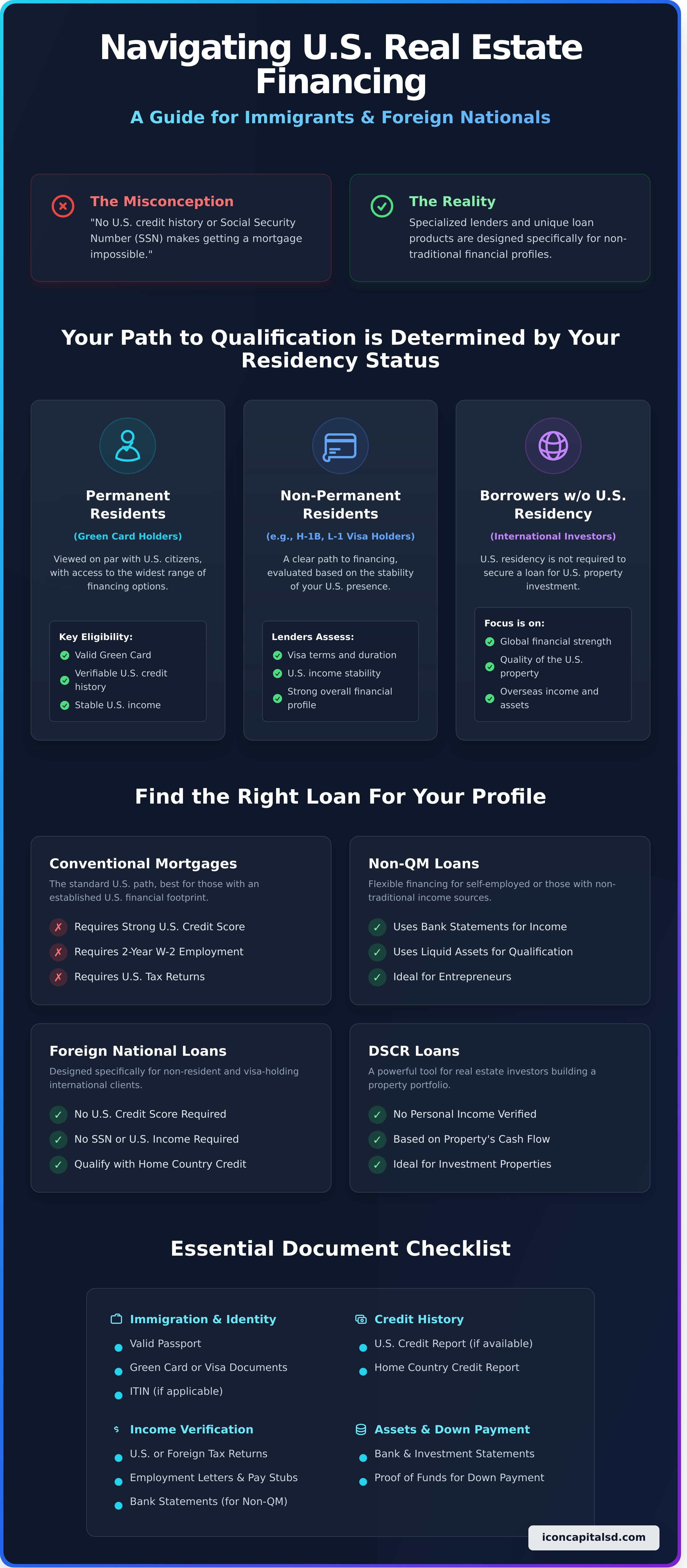
Permanent Residents (Green Card Holders)
Lawful permanent residents, or Green Card holders, have access to the widest range of financing options. For lending purposes, you are generally viewed on par with U.S. citizens. This means you can qualify for conventional loans backed by Fannie Mae and Freddie Mac, provided you have a valid Green Card, a verifiable U.S. credit history, and stable income. The process is straightforward and mirrors the standard mortgage application.
Non-Permanent Residents (Visa Holders)
Individuals residing in the U.S. on non-permanent visas, such as an H-1B or L-1 work visa, also have a clear path to financing. Lenders will closely evaluate the terms and duration of your visa to assess the stability of your U.S. residency and income. While some conventional lenders may offer programs, this category is a primary market for Foreign National Loans, which are specifically structured for non-permanent residents with strong financial profiles.
Borrowers Without U.S. Residency
It is not necessary to live in the United States to secure a loan for U.S. property. International investors frequently purchase real estate as part of a global portfolio, and this is the core audience for specialized loans for immigrants and foreign nationals. These loan programs are designed to accommodate overseas income, assets, and credit. Instead of focusing on U.S. residency, underwriters assess the borrower’s global financial strength and the investment quality of the U.S. property itself.
Types of Real Estate Loans for Immigrants and Foreign Nationals
Navigating the U.S. real estate market requires understanding the specific mortgage products available. While traditional lenders follow a rigid qualification path, specialized lenders provide flexible financing solutions tailored to the unique financial profiles of immigrants and foreign nationals. The right loan product depends entirely on your residency status, credit history, and income sources.
Conventional Mortgages: The Standard Path
Conventional loans are the most common mortgage type in the U.S., but they present significant barriers for new arrivals. Lenders require a strong U.S. credit score, a two-year history of W-2 employment, and U.S. tax returns for verification. This standardized underwriting, outlined in guides like the home loan process from the CFPB, makes qualification difficult for those without an established U.S. financial footprint. This path is best suited for Green Card holders who have been living and working in the U.S. for several years.
Non-QM Loans: Flexible Financing Solutions
Non-Qualified Mortgages (Non-QM) are designed for borrowers who fall outside the strict federal guidelines of conventional lending. For self-employed immigrants or those with income from multiple sources, solutions like Bank Statement or Asset Qualification loans are ideal. Instead of tax returns, these programs use verified bank deposits or liquid assets to establish income, providing a direct path to financing for entrepreneurs and professionals with non-traditional earnings.
Foreign National Loans: Designed for International Buyers
As the primary financing tool for non-resident and visa-holding borrowers, Foreign National loans are structured specifically for international clients. These specialized loans for immigrants and foreign buyers typically do not require a U.S. credit score, Social Security Number, or U.S.-based income. Underwriters instead verify the borrower’s credit history in their home country and use foreign income sources and assets for qualification.
DSCR Loans: For Real Estate Investors
For immigrants focused on building a real estate portfolio, the Debt Service Coverage Ratio (DSCR) loan is a powerful tool. Qualification is not based on personal income but on the investment property’s cash flow. The lender primarily assesses whether the projected rental income will cover the mortgage payment and other expenses. This allows investors to scale their portfolios based on the performance of their assets rather than personal W-2 income.
| Feature | Conventional Loan | Non-QM Loan | Foreign National Loan | DSCR Loan |
|---|---|---|---|---|
| U.S. Credit Score | Required (Typically 620+) | Varies (Flexible) | Not Required | Often Required (Varies) |
| Income Documentation | U.S. Tax Returns / W-2s | Bank Statements / Assets | Foreign Income Verified | Property Cash Flow |
| Typical Down Payment | 3-20% | 10-25% | 25-40% | 20-30% |
The Application Process: A Step-by-Step Document Checklist
A successful application for loans for immigrants hinges on comprehensive and organized documentation. Lenders require a clear financial picture to assess risk and verify your ability to repay the loan. Preparing these documents in advance streamlines the underwriting process and demonstrates your readiness as a borrower. This checklist outlines the essential items required to build a strong loan application file.
Essential Personal and Financial Documentation
The foundation of your application is proving your identity, legal status in the U.S., and financial capacity. Underwriters will require clear, current copies of these core documents to begin their review. Ensure all documents are legible and complete.
- Proof of Identity and Status: A valid, unexpired passport from your country of origin and your current U.S. visa or Permanent Resident Card (Green Card).
- Proof of Income: Recent pay stubs, an employment verification letter from your U.S. employer, and/or two years of foreign tax returns.
- Asset Verification: Bank and investment account statements (typically for the last 2-3 months) from both U.S. and foreign institutions to verify funds for the down payment and reserves.
Building Your Case Without a U.S. Credit Score
A lack of a Social Security Number (SSN) or a U.S. credit history is a common challenge. Lenders specializing in loans for immigrants understand this and accept alternative forms of credit validation. The goal is to demonstrate a consistent history of meeting financial obligations.
- International Credit Reports: Many lenders can accept and evaluate a credit report from your home country.
- Alternative Credit Data: Provide 12 months of canceled checks or bank statements showing consistent, on-time rent or utility payments.
- Financial References: A formal letter of reference from a foreign banking institution can serve as a powerful testament to your creditworthiness.
Beyond the paperwork, effectively communicating your financial stability and plans to lenders is key. For those looking to enhance their professional communication and ensure every detail is conveyed with clarity, enrolling in an American Accent Program can be a valuable step in building confidence for these important financial discussions.
Understanding Down Payment Requirements
For non-resident loans, expect a higher down payment requirement, typically in the 20-30% range. This larger equity position reduces the lender’s Loan-to-Value (LTV) ratio, directly mitigating their risk on the investment. A substantial down payment is one of the most critical factors in securing loan approval. Lenders will also require that these funds are “seasoned”—meaning they have been in your verified bank accounts for at least 60-90 days—to confirm a legitimate source.
Navigating Common Hurdles in Immigrant Lending
Securing loans for immigrants can present unique challenges, but these are manageable with the right expertise. While traditional banks may struggle with non-standard documentation, an expert in Non-QM and foreign national lending views these as routine checkpoints, not roadblocks. Understanding these common hurdles and their practical solutions is the first step toward a successful application.
Challenge: Verifying Foreign Income and Assets
Lenders must verify that your income is stable and likely to continue. When your financial history originates overseas, this requires extra steps. Specialized lenders work with trusted third-party services to translate and validate international income statements, tax documents, and asset reports. Your foreign currency is converted to USD to determine your precise qualification, ensuring a clear and accurate financial picture for underwriting.
Challenge: Complex Visa or Immigration Status
Your legal status in the U.S. is a critical component of your loan application. An experienced lender understands the nuances between different visa categories, such as H-1B, L-1, or E-2. The primary requirement is a visa that permits long-term residence and employment. A loan officer proficient in these scenarios can navigate this documentation, ensuring your status is correctly presented to underwriters without unnecessary delays.
Challenge: Finding the Right Lender
Large retail banks often operate with rigid, automated underwriting systems that reject applications with international complexities. The solution is to partner with a lender specializing in Non-QM and foreign national programs. These experts offer specific loan products for immigrants and have established, transparent processes for international clients. A specialist will guide you through the requirements efficiently, saving you time and frustration. Request a quote to see how we can help.
Why Icon Capital LLC is a Premier Lender for Immigrants and Foreign Nationals
Navigating the U.S. mortgage market presents unique obstacles for foreign nationals and new residents. Traditional lenders often lack the flexibility to underwrite complex international financial profiles, leading to unnecessary denials. Icon Capital LLC was built to fill this gap, providing effective loans for immigrants and foreign nationals where conventional banks cannot. We are a direct lender, giving us the authority to make common-sense underwriting decisions based on your complete financial picture.
Our Specialization in Non-QM and Foreign National Loans
We specialize in Non-Qualified Mortgage (Non-QM) and Foreign National loan programs specifically designed to overcome the hurdles of traditional financing. Our underwriting process is not solely reliant on standard W-2s or a long-standing U.S. credit history. Instead, we have a clear and established methodology for assessing alternative qualifications, including:
- International Credit Reports: We can utilize credit data from your country of origin.
- Alternative Income Verification: We review bank statements (12 or 24 months) or asset-based statements to verify income.
- DSCR for Investors: For investment properties, we can qualify the loan based on the property’s cash flow (Debt Service Coverage Ratio) rather than personal income.
This flexible approach allows us to structure a loan that aligns with your real estate investment objectives, whether you are purchasing a primary residence or scaling a U.S. rental portfolio.
A Streamlined Process for International Clients
Securing financing from abroad or as a new resident requires navigating complex documentation. Our loan specialists possess extensive experience with the specific paperwork required for international clients, from visa verification to foreign asset statements. We provide direct, professional guidance at every stage, ensuring a transparent and efficient underwriting process. Our primary objective is to facilitate a fast, seamless closing so you can focus on your investment.
Begin Your U.S. Real Estate Journey Today
Your residency status should not be a barrier to U.S. property ownership. Icon Capital LLC provides the specialized loans for immigrants and foreign investors needed to enter or expand within the U.S. real estate market. We deliver creative financing for complex situations that fall outside the rigid criteria of traditional lenders.
Take the first step toward securing your property. Request a free, no-obligation quote from our specialists. Our team is ready to assess your scenario and structure a viable loan solution.
Finalizing Your U.S. Real Estate Financing Strategy
Navigating the U.S. property market as an immigrant investor presents unique hurdles, but success is achievable with the right strategy. This guide has demonstrated that eligibility is determined by your complete financial and legal profile, not just residency status, and that a range of specialized financing products exists to meet your specific needs.
Successfully securing financing requires a partner with proven expertise in this niche. Icon Capital specializes in Foreign National and Non-QM loans, delivering creative financing for the complex scenarios traditional lenders avoid. We leverage our deep expertise in U.S. real estate investment to structure effective loans for immigrants and build client portfolios.
Your U.S. property acquisition is within reach. Take the definitive next step. Request a Quote to Explore Your U.S. Property Financing Options and allow our team to engineer a solution for your investment goals.
Frequently Asked Questions
Can I get a real estate loan with an ITIN number instead of an SSN?
Yes, securing a real estate loan with an Individual Taxpayer Identification Number (ITIN) is possible. Many Non-QM lenders offer specific ITIN loan programs designed for borrowers who do not have a Social Security Number. Qualification will be assessed based on other financial factors, including your credit history, verifiable income, asset reserves, and the size of your down payment. Working with a lender experienced in non-traditional financing is key to a successful application.
What is the typical minimum down payment for a foreign national loan?
The minimum down payment for a foreign national loan typically ranges from 20% to 30%. The precise requirement is determined by the lender and depends on factors like the property type (e.g., primary residence vs. investment), loan amount, and the borrower’s overall financial profile. For certain properties or larger loan amounts, some lenders may require a down payment closer to 40% to offset the perceived risk associated with the transaction.
Are interest rates significantly higher for immigrant loans?
Interest rates for immigrant loans can be higher than conventional mortgages, but the difference is based on risk assessment, not always significant. The final rate is influenced by your credit history, down payment size, loan-to-value (LTV) ratio, and your specific visa status. Lenders specializing in loans for immigrants often provide competitive pricing by evaluating the complete financial strength of the applicant, including international assets and credit.
Do I need to have a U.S. bank account to apply for a mortgage?
Yes, a U.S. bank account is a standard requirement for a mortgage application. Lenders require it to verify the assets you will use for the down payment and closing costs, and to document a clear paper trail for the source of those funds. This account is also necessary for processing the loan disbursement at closing and for setting up automated mortgage payments. Establishing this U.S. banking relationship is a critical first step.
How long does the mortgage approval process take for a non-permanent resident?
The mortgage approval process for a non-permanent resident typically takes between 30 and 60 days from application to closing. The timeline can be slightly longer than for a standard conventional loan due to the need for additional documentation. This may include verification of your visa status, work authorization, and the potential translation and validation of financial documents from your home country. An experienced lender can help streamline this process.
Can I use funds from my home country for the down payment?
Yes, you can use funds from your home country for the down payment and closing costs. However, you must provide a clear and verifiable paper trail for these assets. Lenders will require documentation showing the funds being transferred from your foreign bank account into a U.S.-based account. Be prepared to submit several months of bank statements from both accounts to prove the funds are seasoned and legitimately yours.
Does my spouse’s immigration status affect our joint loan application?
Yes, your spouse’s immigration status is a critical factor in a joint loan application. Lenders will evaluate the eligibility of both applicants, including their legal status and right to earn income in the U.S. If one spouse has a non-qualifying or less stable immigration status, it may impact the loan terms or overall approval. In some scenarios, it may be more strategic for the spouse with the stronger qualifying profile to apply individually.