

As a self-employed professional, your tax returns tell a strategic story for the IRS-one of maximized deductions and minimized tax liability. But when it’s time to secure a mortgage, that same story often leads to loan denials. This common obstacle for entrepreneurs and independent contractors is precisely why traditional lenders fail to see your true financial strength. Fortunately, there is a direct financing solution designed for your business structure. 1099 Income Home Loans allow you to qualify for a mortgage based on your gross income, documented by your 1099 forms, without requiring tax returns.
This guide eliminates the confusion surrounding the self-employed mortgage process by providing a clear roadmap to approval. You will learn the exact documentation required, understand how underwriters assess your qualifications using gross income, and gain the confidence to secure the financing you need for your primary residence or next investment property. It’s time to get approved based on your actual earning power.
Key Takeaways
- Qualify for a mortgage using your 1099 forms as income verification, bypassing the need for traditional tax returns.
- Understand the specific documentation and lender requirements needed to secure financing as a self-employed borrower.
- Determine if 1099 Income Home Loans are the most effective financing solution for your situation compared to other Non-QM products.
- Learn how partnering with a Non-QM specialist simplifies the application process and improves your chances of a successful closing.
What Is a 1099 Home Loan and How Does It Work?
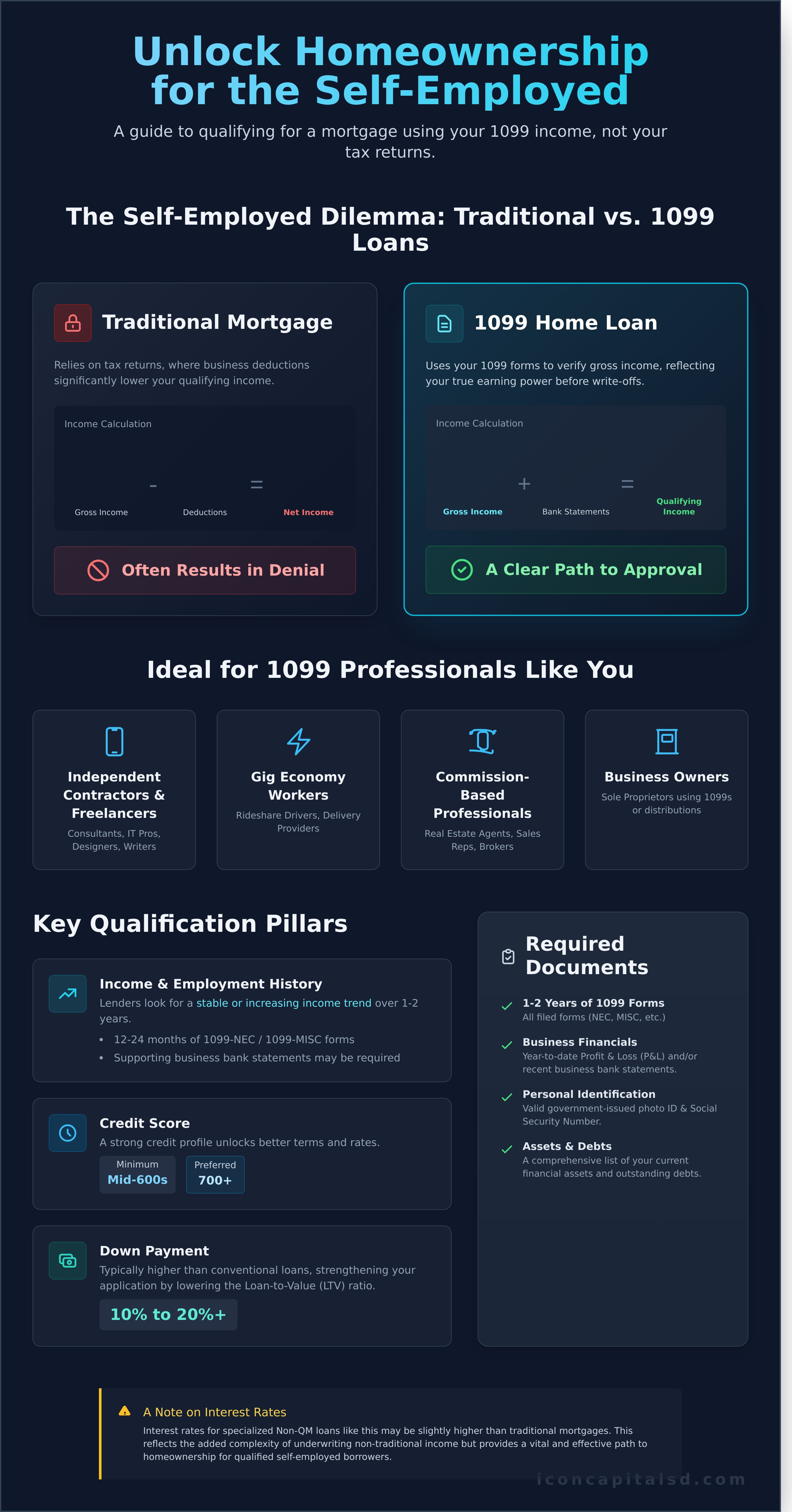
A 1099 home loan is a specialized Non-Qualified Mortgage (Non-QM) designed specifically for self-employed borrowers. Its primary function is to solve a critical problem faced by entrepreneurs and independent contractors: qualifying for a mortgage using gross income instead of the adjusted gross income reported on tax returns. Traditional lenders rely on your net income after business deductions, which can significantly reduce your qualifying power.
This loan program bypasses that obstacle. By verifying income through 12 or 24 months of 1099 forms and corresponding bank statements, lenders can assess your true cash flow before write-offs. This provides a more accurate financial picture, making it a powerful tool for individuals whose tax returns do not reflect their full earning capacity. It is a direct financing solution for the modern workforce.
Who is This Loan Program For?
This mortgage product is structured for professionals who receive a Form 1099-NEC or 1099-MISC instead of a W-2. It is an ideal solution for a growing segment of the economy, including:
- Independent Contractors and Freelancers: Consultants, IT professionals, graphic designers, and writers.
- Gig Economy Workers: Rideshare drivers, delivery service providers, and other app-based workers.
- Commission-Based Professionals: Real estate agents, mortgage brokers, and sales representatives.
- Business Owners: Sole proprietors who pay themselves via distributions or 1099s.
The Key Advantage: Bypassing Tax Returns
The fundamental advantage of 1099 Income Home Loans is the method of income verification. Conventional mortgages require a deep analysis of your tax returns, specifically the net profit or loss shown on Schedule C. This standard approach creates a significant hurdle for individuals engaged in self-employment, where maximizing legitimate business deductions is a key financial strategy.
While excellent for tax purposes, these write-offs reduce the income used for mortgage qualification, often resulting in a lower loan amount or an outright denial. A 1099 loan assesses your ability-to-repay based on documented gross earnings, offering a direct reflection of your business revenue and true cash flow before deductions are applied.
Qualifying for a 1099 Loan: Requirements & Documentation
Securing a mortgage as a 1099 worker involves a different qualification process than for a W-2 employee. Lenders offering 1099 income home loans focus on demonstrating consistent income and financial stability through alternative documentation. The core pillars remain the same-income, credit, down payment, and employment history-but the method of verification is tailored to the nature of self-employment. While the requirements are distinct, they are not necessarily more difficult; they simply require a different approach to proving your ability to repay the loan.
Income Verification and Employment History
Lenders will analyze your income stream to assess its stability and trajectory. This typically requires one to two years of filed 1099-NEC or 1099-MISC forms. Underwriters look for a stable or increasing income trend, as this demonstrates business viability. To support your application, you may also need to provide 12-24 months of business bank statements or a verification letter from a primary client. Some loan programs accommodate income from multiple 1099 sources, while others may prefer a history with a single, consistent client.
Credit Score and Down Payment Requirements
Your financial profile plays a crucial role in qualification. Minimum FICO scores for these programs often start in the mid-600s, but a higher score (700+) will unlock more favorable interest rates and terms. Expect down payment requirements to be higher than conventional loans, typically ranging from 10% to 20% or more. This directly impacts your loan-to-value (LTV) ratio, a key metric lenders use to evaluate risk. A lower LTV, achieved through a larger down payment, significantly strengthens your application.
Required Document Checklist
To streamline the underwriting process for 1099 income home loans, it is critical to have your documentation organized and ready. A standard submission package includes:
- One to two years of all filed 1099 forms (NEC, MISC, etc.)
- Year-to-date profit and loss (P&L) statement and/or recent business bank statements
- A valid, government-issued photo ID and your Social Security Number
- A comprehensive list of your current assets and outstanding debts
It is important to set realistic expectations. Interest rates for these specialized non-QM loan products may be slightly higher than those for traditional QM loans. This reflects the additional complexity involved in underwriting non-traditional income streams, but for a qualified borrower, it provides a direct and effective path to homeownership.
1099 Loans vs. Other Self-Employed Mortgage Options
A 1099 loan is a specific tool within the broader category of Non-QM (Non-Qualified Mortgage) financing. For many independent contractors, it is the most direct path to securing a mortgage. However, understanding how it compares to other options is critical for determining the most efficient financing solution for your specific circumstances.
The right loan program depends entirely on how your income is documented and the structure of your business. The goal is to use the documentation that best reflects your true purchasing power.
Key Differences in Self-Employed Loan Programs
This table provides a direct comparison of the most common mortgage options available to self-employed borrowers.
| Loan Type | Primary Income Document | Income Calculation Basis | Ideal Borrower Profile |
|---|---|---|---|
| 1099 Loan | 1-2 years of 1099 forms | Gross revenue shown on 1099s | Independent contractors and gig workers with high business write-offs. |
| Traditional (Agency) | 2 years of full tax returns | Net income after all deductions | W-2 employees or self-employed individuals with very low business expenses. |
| Bank Statement Loan | 12-24 months of bank statements | Average qualified deposits | Business owners with substantial cash flow and deposits from multiple sources. |
| P&L Statement Loan | CPA-prepared Profit & Loss | Net income shown on P&L | Owners of established businesses with formal accounting and a CPA relationship. |
Choosing the Right Path: 1099 vs. Other Solutions
The fundamental advantage of 1099 income home loans over traditional financing is the use of gross income instead of the net income reported on your tax returns. If you are a savvy business owner who maximizes tax deductions, a traditional loan will severely understate your qualifying income. A 1099 loan bypasses this issue entirely.
When compared to other Non-QM options, a 1099 loan offers simplicity. A bank statement loan is better suited for a business owner whose revenue isn’t cleanly captured on 1099s-for example, a retail business with thousands of small transactions. A P&L loan is designed for a more formally structured business (like an S-Corp) that has a CPA managing its finances. For the professional who is paid directly as a contractor, the 1099 loan is often the most streamlined and logical solution.
The Application Process: A Step-by-Step Guide
Navigating the mortgage process with non-traditional income can seem complex, but it is a structured and manageable journey. At Icon Capital LLC, we simplify the path to financing by breaking it down into four distinct stages. This step-by-step guide demystifies the process for 1099 income home loans, providing a clear roadmap from your initial inquiry to receiving the keys to your new property.
Step 1: Initial Consultation and Pre-Qualification
The first step is a direct consultation with a loan officer who specializes in Non-QM financing. You will discuss your specific income structure and financial goals. To prepare, gather your most recent 1099 forms and any relevant bank statements. This allows us to provide a realistic assessment of your borrowing power and outline potential loan terms. Request a free quote to begin this crucial first step.
Step 2: Formal Application and Documentation Submission
Once you are ready to proceed, you will complete the Uniform Residential Loan Application (URLA). Our team will provide a comprehensive checklist of all required documentation, which you can submit through our secure portal. During this phase, we will also order a professional appraisal of the property you intend to purchase to determine its fair market value.
Step 3: Underwriting and Approval
Your complete application file is submitted to an underwriter who has direct experience with self-employed borrowers. They will conduct a thorough review, verifying your income, asset statements, and credit history to ensure all program guidelines are met. The underwriter may request additional information for clarification. Upon a successful review, you will receive a conditional loan approval.
Step 4: Closing
With underwriting approval secured, the final loan documents are prepared and sent to you and the title company for review. You will schedule a closing appointment to sign the paperwork with a notary. After the documents are signed and the loan is officially funded, the transaction is complete. You are now a homeowner.
The process for securing financing with 1099 income is straightforward when you work with a knowledgeable lender. To explore your options and partner with an expert, visit us at iconcapitalsd.com.
Partner with an Expert in 1099 and Non-QM Lending
Navigating the mortgage process with 1099 income presents unique challenges. Many traditional lenders and brokers lack the framework to accurately assess the financial profile of a self-employed borrower, often leading to delays and unnecessary denials. Working with a specialist is not just an advantage-it is critical for a smooth and successful transaction.
Icon Capital has deep expertise in structuring the creative financing solutions that self-employed professionals and real estate investors require. We operate exclusively in the Non-QM space, providing direct access to loan products designed specifically for complex income scenarios.
Why Choose a Specialist Like Icon Capital?
Our entire process is built to serve borrowers who fall outside conventional lending guidelines. We provide clarity and efficiency where others create complexity. Key advantages of our approach include:
- Diverse Product Access: We offer a wide range of Non-QM products, including bank statement loans, asset utilization, and DSCR loans, ensuring we can structure the optimal solution for your specific needs.
- Expert Loan Officers: Our team understands the nuances of business cash flow, asset leverage, and investment portfolios. We analyze your complete financial picture, not just a single tax document.
- A Streamlined Process: We have engineered our loan process for speed and efficiency, minimizing documentation burdens and accelerating closing timelines for our clients.
- Versatile Solutions: We provide financing for primary residences, second homes, and a wide range of investment properties, from single-family rentals to large multi-family assets.
This specialized focus means we are uniquely equipped to handle the complexities of 1099 income home loans. Our goal is to remove common roadblocks and deliver a clear, direct path to funding for your next property.
Take the Next Step
Your 1099 status should not be a barrier to homeownership or portfolio growth. The right financing solution is available when you partner with a lender who specializes in your financial structure.
The first step is a professional review of your scenario. Let our experts assess your qualifications and outline your best options. Request a no-obligation quote today.
Unlock Your Home Buying Power with a 1099 Loan
For entrepreneurs and independent contractors, the path to homeownership is not defined by W-2s and traditional tax returns. This guide has demonstrated that your self-employed status is an asset, not a liability. The key takeaway is that 1099 Income Home Loans are specifically designed to evaluate your true financial standing using alternative documentation like bank statements. This modern approach to lending bypasses the typical roadblocks, allowing your real-world cash flow to qualify you for the property you deserve.
Partnering with a lender who specializes in Non-QM and self-employed financing is critical to a successful outcome. At Icon Capital, we deliver creative financing solutions for investors and entrepreneurs. Our expertise ensures a streamlined process, enabling fast closings and removing unnecessary complexity from your transaction. We structure loans based on assets and real income, not just tax forms.
Ready to move forward? Request a Quote to Explore Your 1099 Loan Options and put our expertise to work for you. Your real estate goals are within reach.
Frequently Asked Questions About 1099 Income Home Loans
Can I get a 1099 loan if I have forms from multiple clients?
Yes. Receiving 1099s from multiple sources is standard for independent contractors and business owners. Lenders will aggregate the income from all sources to determine your qualifying income. The primary requirement is demonstrating a stable and consistent income history, typically over a 12 to 24-month period, regardless of the number of clients you have.
What is the typical interest rate for a 1099 income mortgage?
Interest rates for 1099 loans are generally higher than conventional W-2 mortgages due to the perceived risk of variable income streams. The specific rate depends on factors like your credit score, loan-to-value (LTV) ratio, and overall financial profile. While elevated, these rates are competitive within the non-QM lending market and provide a viable financing solution for self-employed borrowers.
Can I use a 1099 loan to refinance my current home?
Absolutely. 1099 loan programs are available for both home purchases and refinancing. This includes rate-and-term refinances to secure a better interest rate or payment, as well as cash-out refinances to leverage your home’s equity. The qualification process is similar to a purchase, focusing on verifying your self-employed income through bank statements or 1099 forms.
How much of my 1099 income will the lender actually use for qualification?
Lenders calculate a stable monthly figure by averaging your income over the most recent 12 or 24 months. If using bank statements, they may use a fixed percentage of total deposits to account for business expenses. If using tax returns, they will use the net income after deductions. The exact calculation method is determined by the specific loan program you select.
Is it harder to get a 1099 loan than a traditional mortgage?
The process is not harder, but it is different. It requires alternative documentation in place of W-2s and pay stubs. Lenders specializing in 1099 income home loans are experienced in evaluating documents like bank statements and Profit & Loss statements. For a prepared borrower with organized financials, the process can be straightforward and efficient.
Can I use a 1099 loan for an investment property?
Yes. Many 1099 income home loans are structured to accommodate real estate investors purchasing or refinancing non-owner-occupied properties. For investors, lenders may also offer alternative programs like DSCR (Debt-Service Coverage Ratio) loans, which qualify the borrower based on the investment property’s cash flow rather than the borrower’s personal income documentation.
What is the minimum FICO score required for a 1099 loan?
Minimum FICO score requirements vary by lender and specific loan program, but they typically start in the mid-600s. A higher credit score, such as 720 or above, will provide access to more favorable terms, including lower interest rates and higher LTV ratios. Some programs may offer flexibility for lower scores if there are strong compensating factors, like a large down payment.